yahoo Press
Mortgage rate predictions for the next 5 years: An AI-driven forecast through 2030
Images
1 / 12

2 / 12

3 / 12

4 / 12

5 / 12
6 / 12

7 / 12

8 / 12

9 / 12

10 / 12

11 / 12

12 / 12
Some offers on this page are from advertisers who pay us, which may affect which products we write about, but not our recommendations. See our Advertiser Disclosure.

Mortgage rates have hardly moved over the last few weeks — but what about long-term rates? Where are rates headed in the next five years, and should you wait for mortgage rates in particular to decrease before buying or refinancing? Mortgage interest rates are determined by several factors, all of which can give us clues about the future.

Here are the housing market predictions for 2026.

One of the most useful indicators for predicting mortgage rates is the yield on the 10-year U.S. Treasury note. Mortgage rates and 10-year Treasury yields typically move in the same direction, although mortgage rates are usually higher because lenders factor in additional risks. This difference between the two is known as the spread, and we’ll account for that when estimating where mortgage rates could go.

With that in mind, the first step is to look at where economists believe Treasury yields are headed over the next five years. To build a forecast, we’ll combine expert economic projections with data compiled using artificial intelligence.

Michael Wolf, a global economist at Deloitte Touche Tohmatsu Ltd., outlined the firm’s Treasury yield expectations over the next five years in a December update from the Deloitte Global Economics Research Center.

"We assume the Fed leaves rates unchanged until December 2026. The average federal funds rate reaches its neutral 3.125% in the middle of 2027," he wrote. Wolf said the 10-year Treasury yield will ease gradually through the second quarter of 2027, "to settle at 3.9% from the third quarter of 2027 through the end of 2030."

Let's chart that forecast.

Other forecasts point to somewhat higher long-term yields. For example, Goldman Sachs analysts expect the 10-year Treasury to rise over the long term to 4.5% by 2035.

Meanwhile, the Congressional Budget Office (CBO) projects that the 10-year Treasury yield will reach 4.1% by the end of 2026, rising gradually to about 4.3% by 2030.

Anthropic's Claude artificial intelligence compiled the predictions into a consensus forecast, which we will utilize below.

Read more: Why mortgage rates increased after the Federal Reserve rate cut

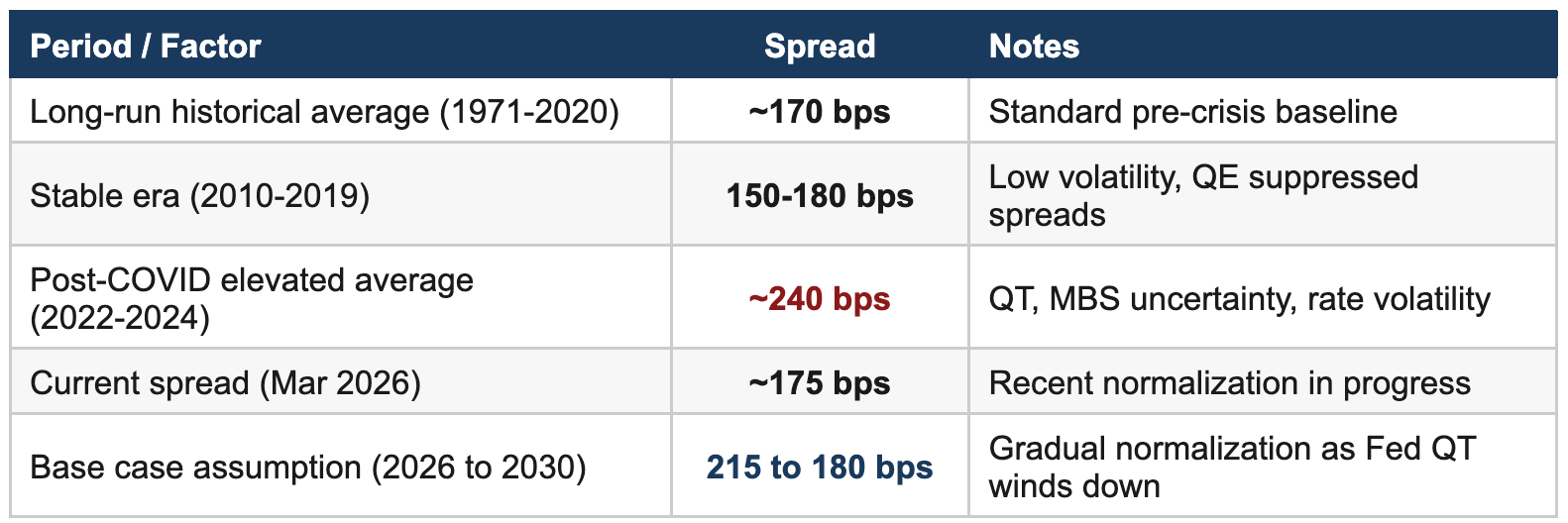
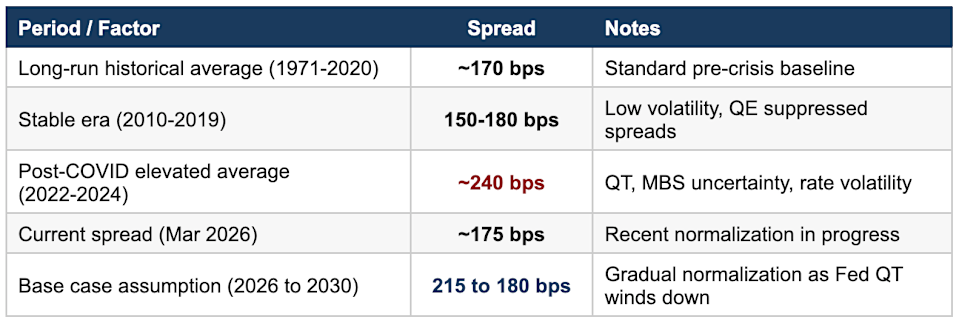
As mentioned, the 10-year Treasury and 30-year fixed mortgage rates are separated by a spread. That difference between the two has been on either side of 2.5 percentage points in recent years. That's a significant change when compared to the spread from 2010 to 2020, when it was under two percentage points — and often near 1.5.

Using a 2-percentage-point spread, here's an example of how Treasurys and mortgage rates compare:

10-year Treasury rate = 4%

Spread = 2 percentage points

Mortgage rates = 6%

Here's a recent example: As of March 5, the 10-year Treasury yield was 4.09%, and the 30-year fixed mortgage rate was 6.00%. The spread was 6.00 - 4.09 = 1.91 percentage points.

The spread is under two percentage points, which is one reason mortgage rates have decreased.

Claude AI suggested using a variable spread that slowly compressed:

"The spread between 30-year fixed mortgage rates and the 10-year Treasury is driven by prepayment risk, credit risk, and supply/demand for mortgage-backed securities (MBS). The Federal Reserve's quantitative tightening (QT) program widened spreads after 2022 as private markets absorbed more MBS. Spreads have begun normalizing in late 2025 and are expected to continue tightening."

Using these spread estimates, we can now complete our five-year mortgage rate forecast.

Using the Treasury forecast, we add the Claude-suggested base case assumed spread between the bond market and 30-year fixed mortgage rates to compile a five-year forecast:

Read more: When will mortgage rates will go back down to 6%?

While this forecast is for a base case with gradual normalization to the spread, the easing of inflation, and modest Fed monetary policy, Claude AI also prepared a "bull" estimate and a "bear" estimate:

"The Fed successfully guides inflation back to 2% without a hard recession. Gradual FOMC rate cuts through 2027 pull the 10-year yield to 3.3% as the term premium compresses. The MBS spread normalizes toward its long-run average of 170 bps as QT ends and private MBS demand recovers. Result: a 30-year fixed rate near 5.00% by 2030."

"Inflation remains sticky above 2.5% and mounting U.S. fiscal deficits push the term premium higher, keeping the 10-year yield near 4.4 to 4.6%. The spread widens to 240 bps as market volatility and MBS supply weigh on secondary markets. Mortgage rates climb toward 7.00% by 2027 before easing slightly to 6.60% by 2030."

Of course, these are long-range estimates based on historical norms and broad expectations. All of these numbers could be thrown out the window if any of the following happens:

The 10-year Treasurys outperform or underperform the forecast. For example, yields could crash in a severe economic setback, such as a recession, or soar on mounting government deficits

The spread between Treasurys and mortgage rates narrows — or dramatically widens.

Monetary policy, as driven by the Federal Reserve, substantially changes.

There is no forecast that predicts a 3% mortgage rate in the next five years. However, who saw such low home loan rates on the horizon in 2007 when rates were about where they are now? Things like the Great Recession and a global pandemic are rarely on the radar, and such drastic events are what it takes to move mortgage rates into the cellar.

The analysis above predicts 2027 mortgage rates to be near 6%.

Based on the estimates above, mortgage rates are not expected to drop significantly in the next five years. However, a recession or other unknown disruption to the economy (such as a financial collapse or another pandemic) could change the outlook.

If you are considering an adjustable-rate mortgage with an initial fixed-rate period, you will first want to consider how long you will actually remain in the house you are financing. Then the long-term mortgage rate forecasting begins. The best approach is probably to select the initial term that best suits your current budget.

Read more: 8 strategies for getting the lowest mortgage rate possible

Mortgage rates inched lower this week as an upbeat jobs report bumped the bond market slightly higher.

With mortgage rates hovering around 6%, is now a good time to refinance your loan? Learn about the factors to consider when deciding if you should refinance.

While 2025 brought a resilient economy, 2026 is sure to be full of changes. See our predictions for the next year and how your personal finances may be affected.

To buy a house before the end of 2025, you should know what to expect and how to prepare. Learn how to put yourself in a position to buy before the end of the year.

Will the Fed cut interest rates in 2026? We reached out to economic experts for their Fed rate predictions. Here’s what they had to say.

If you want to refinance your mortgage before the end of 2025, you're in luck. It may be a good time. Learn the steps to take to refi in the next couple of months.