yahoo Press
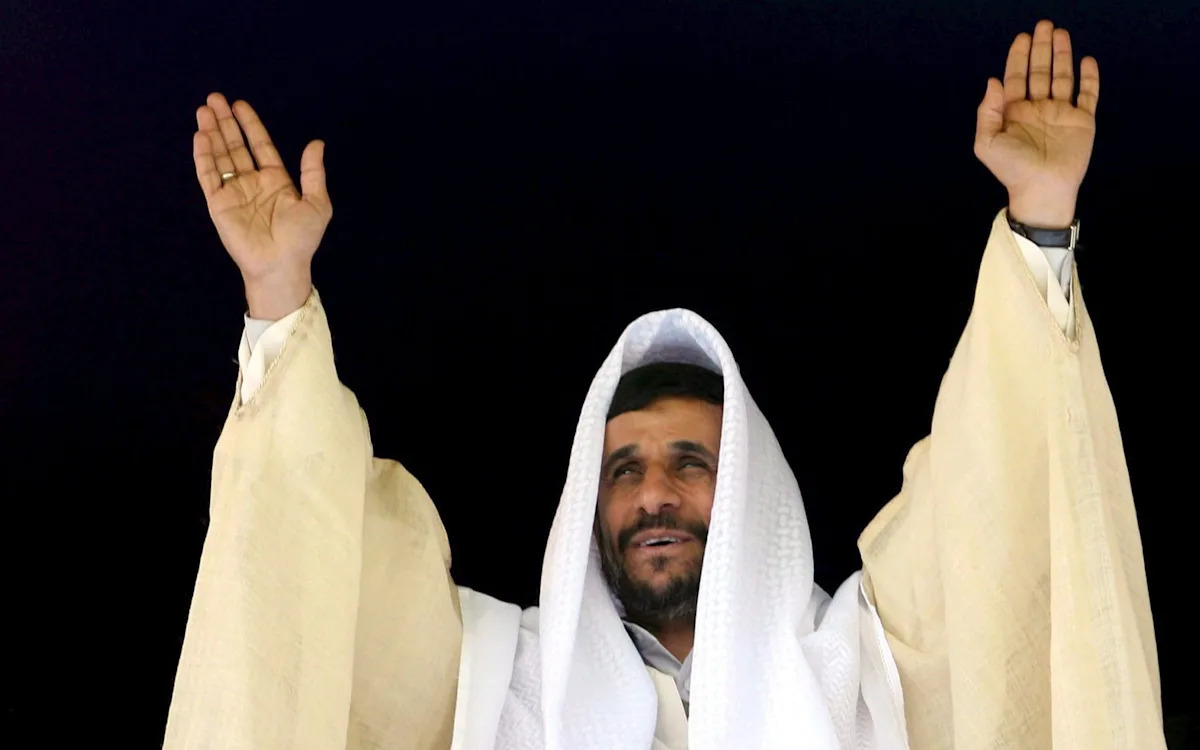
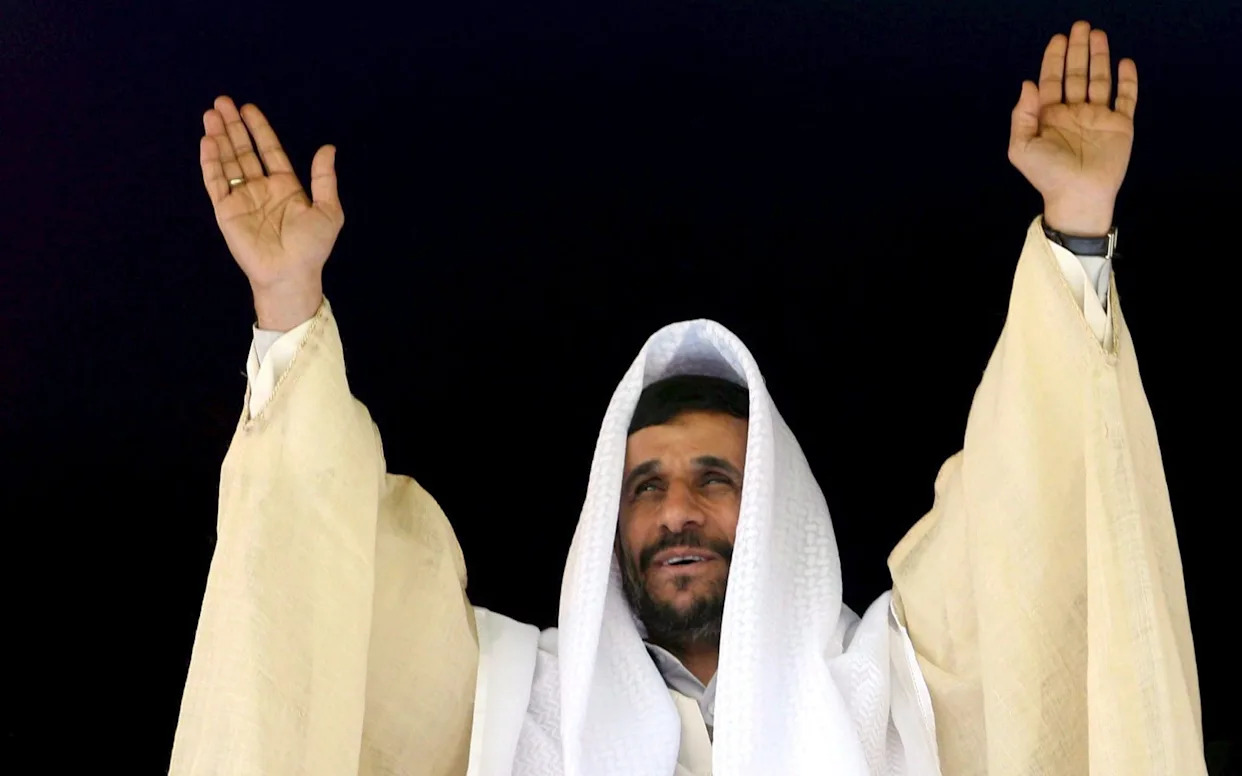
Mahmoud Ahmadinejad, former President of Iran who was a zealous hardliner with popular appeal
Images

1 / 17
2 / 17

3 / 17

4 / 17

5 / 17

6 / 17
7 / 17
8 / 17
9 / 17
10 / 17
11 / 17
12 / 17
13 / 17

14 / 17

15 / 17

16 / 17

17 / 17
​Mahmoud Ahmadinejad, the former President of Iran (2005-13), who has died aged 69, was an obscure figure when he was appointed mayor of Tehran in the spring of 2003, and not particularly well known when he won the second round run-off vote in the 2005 presidential election; yet over the next five years he established himself firmly as the West’s favourite bogeyman.

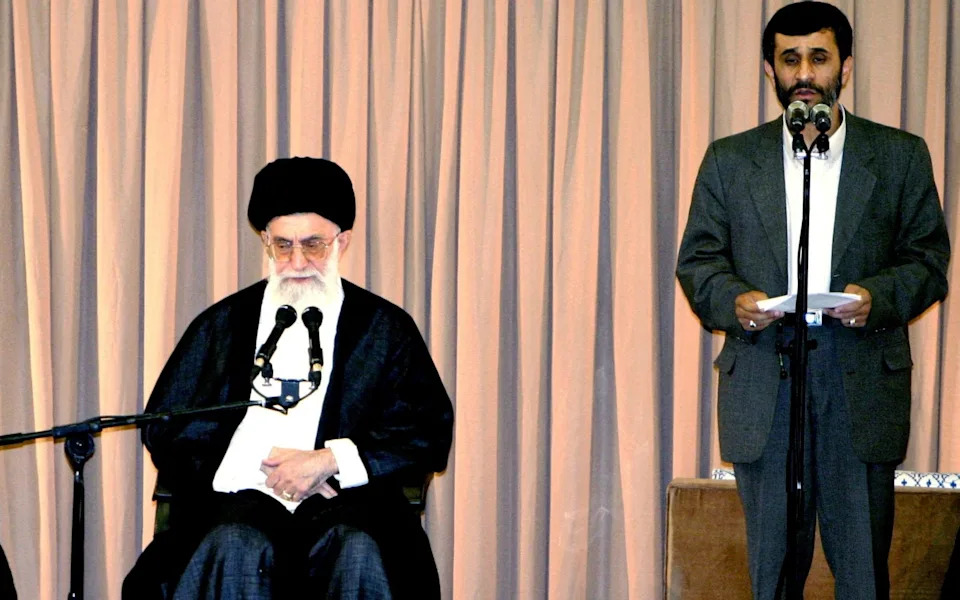
In 2005 the international community anticipated a win for the incumbent president Ali Akbar Hashemi Rafsanjani, so Ahmadinejad’s landslide victory took the world by surprise. Ahmadinejad reportedly spent no money on the campaign, but he was backed by powerful conservatives who used their network of mosques to mobilise support among their mainly working-class congregations. He also had the support of a group of younger, second-generation revolutionaries known as t​he Abadgaran, or Developers, who were strong in the Iranian parliament. Most important of all he had the support of the Supreme Leader, Ayatollah Ali Khamenei and the Iranian Revolutionary Guard, the 120,000-strong force created in 1979 to protect the Islamic Revolution

Ahmadinejad focussed his domestic platform on poverty, social justice and the distribution of wealth inside Iran, promising to use oil money to cut the gap between rich and poor. If he succeeded, however, it was only because both groups were soon struggling to make ends meet. After his election Ahmadinejad embarked on a programme of bringing Sharia law to bear on Iran’s independent banking sector, which was crippled by a raft of restrictive measures. A low-interest loans scheme for small businesses, designed to encourage job creation, collapsed.

Millions were spent on populist measures, such as the “Love Fund” to help poor young men meet the costs of marriage, and the minimum wage was raised by 60 per cent. The inevitable result was a huge exodus of capital as thousands of Iranian companies moved to Dubai and other places, followed by soaring rates of inflation and unemployment and plummeting economic growth. Even petrol was soon being rationed.

The principal beneficiaries of Ahmadinejad’s mismanagement were the leaders of the Revolutionary Guard who were given top jobs in the administration and awarded huge government contracts, allowing them to make inroads into such strategic areas as oil and gas, infrastructure, telecommunications, missile development, nuclear energy, as well as less savoury operations.

Millions of dollars worth of oil revenue was thought to have disappeared into individual pockets as the Guard mo​ved seamlessly into building airports, producing oil and opening mobile phone networks. In 2007, 150 parliamentarians – just over half of Iran’s 290 MPs – took the extraordinary step of signing a letter blaming Ahmadinejad for the country’s woes. By 2009 some 20 percent of the population were below the national poverty line.

Ahmadinejad’s response to criticism was to play the nationalist card by attacking foreign “enemies”- Israel, the United States and that reliable old bugbear, Britain. Shortly after he became Iran’s president in 2005, he achieved global fame by calling the Holocaust a “myth” and inviting a motley collection of deniers and anti-semites to a conference in Tehran. His guests ranged from a former chief of the Ku Klux Klan to a raft of pseudo-historians.

Most notoriously of all, Ahmadinejad later told a cheering crowd that Israel should be “wiped off the map”. His acolytes disputed this translation – although it was good enough for the official news agency, IRNA, when it reported his speech. He provoked further tension with the West by calling the September 11 attacks a “big fabrication” designed to justify a more aggressive US foreign policy.

Ahmadinejad also vigorously defended his ​country’s nuclear programme, insisting that Iran had a right to civilian nuclear energy and denying charges that the country was pursuing nuclear weapons. He continued his defiance despite the reporting of Iran’s nuclear programme to the UN Security Council over its failure to declare sensitive enrichment and reprocessing activities to the IAEA. “They should know that the Iranian nation will not yield to pressure and will not let its rights be trampled on,” he told cheering crowds in 2006, and he attacked what he called “intimidation” by the UN, which he accused of being a poodle of the United States.

Ahmadinejad’s anti-diplomacy alienated the international community, but played to a rising wave of nationalism at home, and to the anger felt by the wider Islamic world over Israel and the invasion of Iraq. Nonetheless his re-election in 2009, by a claimed margin of 28 per cent over his reformist rival Mir-Hossein Mousavi, sparked a wave of internal unrest amid allegations that the vote elections had been rigged. In the months that followed, millions of people took to the streets of Tehran and other cities.

But those who hoped for another popular revolution were to be disappointed. The protests were violently repressed by the Basij volunteer militia of the Revolutionary Guards. Leaders of the protests were imprisoned and, in some cases, executed. Just to be extra sure, however, Ahmadinejad threw in his media manipulation tool of choice: Iran’s nuclear programme.

In October 2009 Iran, under international pressure following the exposure of a secret enrichment plant at Qom, agreed in principle to transfer most of its uranium abroad for further processing. But in subsequent months Ahmadinejad repeatedly pulled back from an agreement, seeking to rewrite the terms and flouting deadlines.

In the days leading up to the 31st anniversary of the Iranian Revolution in February 2010, when widespread opposition protests were anticipated, Ahmadinejad ratcheted up international tensions. First came the announcement that Iran had successfully launched a space probe carrying two turtles, a hamster and a worm. Then its nuclear scientists announced that they would maintain their defiance of the West by going ahead with the country’s controversial uranium enrichment programme.

This was followed by an announcement from the Iranian Defence Ministry that it would shortly begin production of “advanced” unmanned drones that would be capable of carrying out “assaults with high precision” against neighbouring states.

Ahmadinejad proceeded to use the anniversary festivities as a platform to issue a succession of headline-grabbing pronouncements. “Iran is now a nuclear state”, he told a pro-government crowd, adding that it could build a nuclear bomb if it wanted to. The West, he said, was “playing games”. All this had the desired effect. Western leaders blew hot and cold and talked of sanctions, while commentators preoccupied themselves with the question of whether confrontation was now back on the agenda. Amid all the fuss the reformist protestors were largely forgotten.

Ahmadinejad’s term ended in 2013 when the more moderate Hassan Rouhani was elected as his successor. Under Rouhani, Iran signed a deal to scale back its nuclear program. For his part, and despite rumours that he would stand again, Ahmadinejad was largely sidelined from Iran’s political elite, while he tried to reinvent himself as a critic of the regime.

The fourth of seven children of a village blacksmith, Mahmoud Ahmadinejad was born on October 28 1956 in Garmsar, 60 miles south of Tehran. In 2009 the Daily Telegraph revealed that his family had adopted the name Ahmadinejad when he was four and that he had previously been known as Sabourjian – a Jewish surname meaning cloth weaver. Experts suggested that his later penchant for hate-filled attacks on Israel could have been an ​overcompensation to hide his past.

Little is known of Ahmadinejad’s early life, but in the early 1970s he came 130th in nationwide exams and won a place at Tehran’s University of Science and Technology to study engineering. Along with other university campuses all over the Islamic World, the Tehran campus was seething with political unrest. Ahmadinejad soon became active in underground, religious-based political movements.

He studied hard, eventually completing a doctorate in traffic planning. When the Islamic revolution finally came in 1979, he was already a well-known figure in the Islamic Association of Students and took part in the struggle to establish the dominance of the Islamists over the leftists following the Shah’s fall. Some of the American diplomats taken hostage in the US embassy in Tehran in 1981 later testified that Ahmadinejad had been one of the hostage takers, but Ahmadinejad himself always denied being involved – as did several of the known hostage takers.

None the less, there was no doubting​ his ideological devotion to the cause. When Saddam Hussein invaded Iran in 1980, starting an eight-year war, Ahmadinejad left an academic career to fight and was soon at the front as a member of the Basij – the volunteer militia allied to the Revolutionary Guard. He joined a special forces unit and took part in at least one sabotage raid deep into Iraqi territory.

With the war against Iraq over, in the early 1990s Ahmadinejad turned to politics. After two stints as a mayor, he became governor of Ardabil province in 1994. His new career received a temporary check three years later when a reforming moderate cleric, Mohammed Khatami, won presidential elections and effectively forced Ahmadinejad back to academia. But Ahmadinejad put the next six years to good use, lecturing and running a radical fundamentalist militia called the Ansar-e Hizbollah.

Increasingly seen as a potential leader by a conservative faction called the Alliance of Builders of Islamic Iran, he was put forward as a potential mayor of Tehran; and in 2003, after the Alliance came to power in City Council elections, he was duly appointed to the post. Khatami’s response was to bar Ahmadinejad from attending cabinet meetings, a privilege normally accorded to mayors of the capital.

Ahmadinejad’s views were hard-line e​ven by the standards of Iran’s leaders. Brooking no compromise with liberal reformers, he ordered the arrest of women wearing make-up and couples seen holding hands in the streets. He denounced burger bars as a symbol of Western decadence and ordered the removal of advertising hoardings featuring David Beckham and George Clooney.

But he was genuinely popular. In contrast to many of Iran’s leaders, he was personally incorruptible and possessed the common touch. As mayor, he would regularly walk to work or spend a day with Tehran’s street cleaners. When ordinary people had complaints, he would see them personally. Playing the patriotic card, he ordered the exhumation of “martyrs” of the Iran-Iraq war from their provincial cemeteries so that they could be reburied and honoured by passers-by in Tehran’s central squares.

As the 2005 presidential poll approached, Iran’s Supreme Leader Grand Ayatollah Khamenei alighted on Ahmadinejad as one of the few hard-liners with some popular appeal. A turning point in his campaign came when he released a short film showing him dining cross-legged on the floor of his simple, working-class home on Tehran’s 72nd square, his wife hidden by her chador. In the next scene, the camera panned through the empty halls of the mayor’s palace, the home of Ahmadinejad’s predecessors, underneath chandeliers and past marble staircases, through French doors to the pool and sauna, the symbols of a corrupt and money-hungry elite at the top of the mullah’s regime. The unspoken contrast with his main rival, the wealthy and urbane Ali Rafsanjani, could hardly have been clearer.

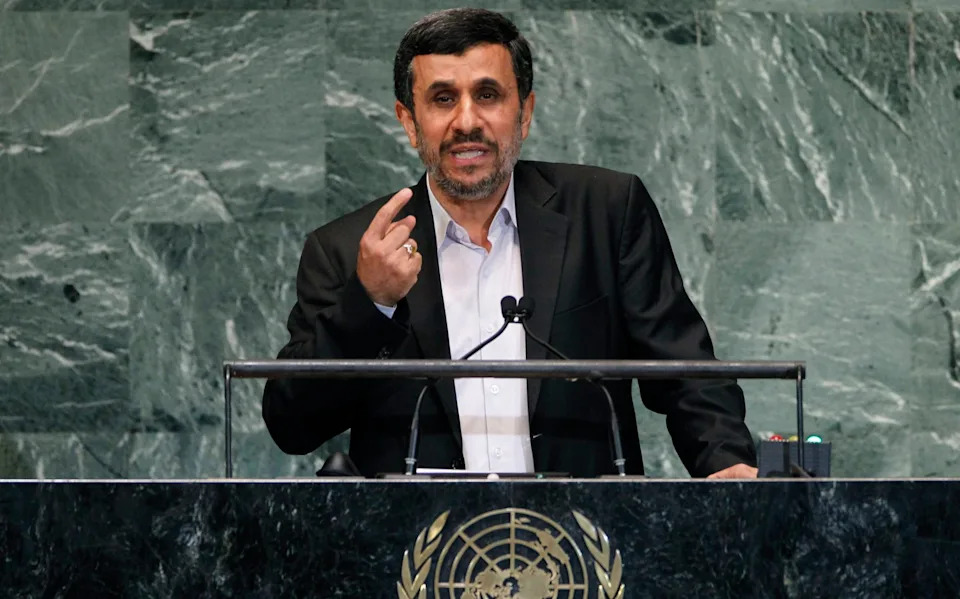
When Ahmadinejad first appeared at the United Nations in September 2005 he seemed unconventional, even shabby in a shapeless jacket, a buttoned-up shirt but no tie, and a mop of carefully parted hair – more like a labourer who had walked in from a Tehran bus station, as one commentator put it. He did not seem a bit threatening. But his determination to advance a radical, religious conservative agenda soon became clear.

World leaders had expected a conciliatory proposal to defuse the escalating nuclear crisis. Instead, they heard Ahmadinejad speak in apocalyptic terms of Iran struggling against an evil West that sought to promote “state terrorism”, impose “the logic of the dark ages” and divide the world into “light and dark countries”. The speech ended with the messianic appeal to God to “hasten the emergence of your last repository, the Promised One, that perfect and pure human being, the one that will fill this world with justice and peace”.

This was a reference to the Hidden Imam or Mahdi, the Messiah-like figure of Shia Islam. Ahmadinejad appeared to believe that his government had been divinely chosen to prepare the country for the Mahdi’s return. One of his first acts on coming to power in 2005 had been to donate about £10 million to the Jamkaran mosque, a popular pilgrimage site near Qom, where the Mahdi would supposedly return.

The problem for Western leaders, as they tried to find some way of engaging with Ahmadinejad, was that few really knew what they are up against. For some, Ahmadinejad was an “over-promoted municipal politician”​ manipulated by conservative factions. For others, he was a dangerous religious fanatic devoted to a bizarre strand of Shia Islam. Yet neither account explained his popular appeal.

Iran watchers tended to argue that the more worrying truth was that Ahmadinejad spoke the truth as it is perceived by tens of millions of people in Iran and hundreds of millions more in the Islamic world. When he attacked Israel and the United States or called for “religious values” in administration, his words had a resonance across the Middle East. Thus, even as they complained about shortages and falling living standards many Iranians rallied to his call. Western leaders who had rested their hopes in the emergence of a new generation of Iranians who were supposedly chafing under the restrictions of the Islamic Republic were left wondering how they had got it so badly wrong.

He was reported to have been killed in a strike that hit his home in northeast Tehran during the February 2026 US-Israeli attack on Iran.

Ahmadinejad and his wife had a daughter and two sons.

​Mahmoud Ahmadinejad, born October 28 1956, died February 28 2026

Try full access to The Telegraph free today. Unlock their award-winning website and essential news app, plus useful tools and expert guides for your money, health and holidays.