yahoo Press
Bitcoin To Crash to $45K? Prediction Markets Polymarket and Kalshi Price in Odds
Images

1 / 6

2 / 6

3 / 6

4 / 6
5 / 6

6 / 6
Key Takeaways

Polymarket and Kalshi give Bitcoin a high chance of hitting $45,000 in 2026.

Bitcoin has struggled below $70,000 since October 2025, with no breakout.

Geopolitical tensions and macroeconomic concerns impact stocks, gold, silver, and crypto markets alike.

Bitcoin’s (BTC) next major move may not be up—at least according to prediction markets.

With BTC hovering near $67,000, traders on Polymarket and Kalshi are increasingly betting on a potential drop toward $45,000.

Contracts on both platforms currently imply about 80% odds that Bitcoin could revisit those levels this year as geopolitical tensions and macroeconomic risks weigh on sentiment.

Prediction markets have become the go-to barometer for Bitcoin’s near-term trajectory, often more accurate than traditional analysts because real money is at stake.

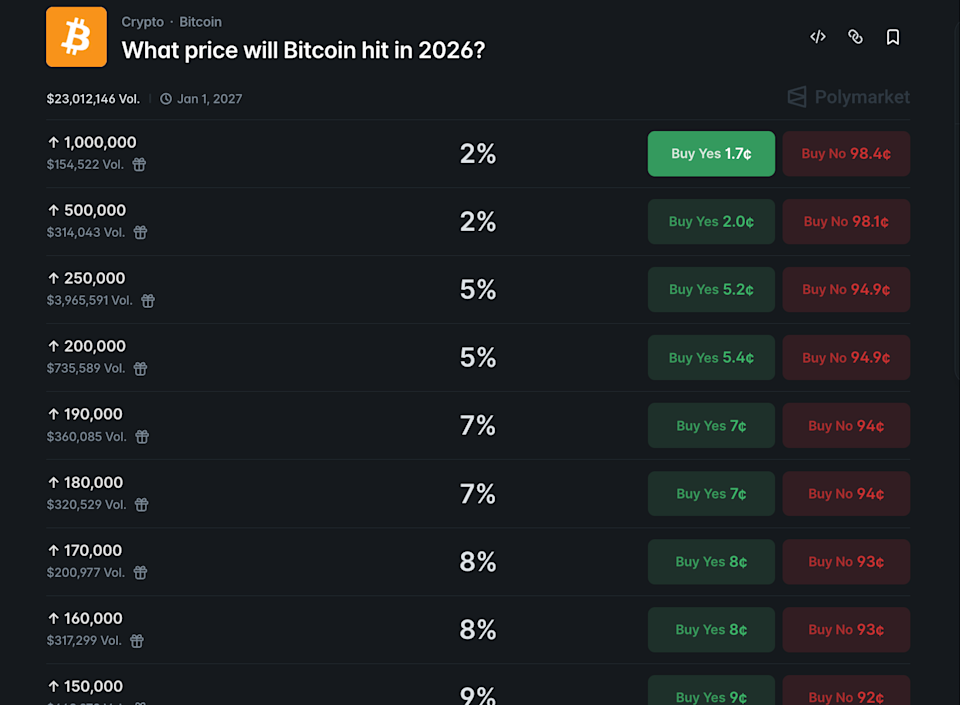
On Polymarket, the “What price will Bitcoin hit in 2026?” market (over $22 million in trading volume) currently assigns a 53% probability that BTC will dip to $45,000 or lower before Dec. 31, 2026.

For context, the odds of hitting $50,000 or less are 67%, while a drop to $55,000 carries a 74% implied probability.

While contracts tied to higher levels — such as $70,000 or above — trade near certainty, the pricing suggests traders are increasingly hedging against deeper downside risks.

A similar tone appears on Kalshi, the regulated U.S. prediction market exchange.

Its contract series “How low will Bitcoin get this year?” currently shows roughly a 48% probability that BTC will fall below $45,000 before Jan. 1, 2027, with “yes” shares trading around $0.49.

The probability rises to 62% for a drop below $50,000, according to Kalshi’s contracts, which have generated more than $1.6 million in trading volume.

The markets settle using the CF Bitcoin Real-Time Index, providing a transparent benchmark for contract resolution.

Traders point to several factors behind the cautious positioning, including persistent selling pressure, periodic ETF outflows during risk-off periods, and Bitcoin’s increasing correlation with traditional markets amid geopolitical tensions.

Some Polymarket users note that demand for the $45,000 downside contract has steadily increased since Bitcoin struggled to convincingly reclaim the $70,000 level.

On Kalshi, several traders appear to be using the contracts as a hedge against the possibility of a 2022-style drawdown.

Even so, long-term sentiment remains broadly constructive.

Many market participants still expect Bitcoin to trade above $70,000 at some point in 2026.

Bitcoin’s journey since late 2025 tells a story of rapid ascent followed by stubborn suppression.

BTC surged above $108,000–$118,000 in October 2025 on post-halving momentum and institutional inflows.

By December, it had slipped to around $87,000, and by March 2026 it trades near $67,000–$68,000, struggling to hold above $70,000.

This suppression isn’t random. After peaking near all-time highs in late 2025, repeated rejection at $70,000–$72,000 levels triggered cascading liquidations.

On-chain data shows long-term holders distributing during rallies, while spot ETF flows have periodically turned negative during risk-off periods.

The result has been a tightening range with support repeatedly tested near $65,000.

Volatility has cooled, but sentiment remains cautious, with traders increasingly hedging against deeper downside — including the $45,000 scenarios now appearing in prediction markets.

Early 2026 is marked by escalating conflict and macroeconomic whiplash, factors that have sent shockwaves through every asset class, including traditional safe havens.

The U.S.-Israel military actions against Iran have disrupted the Strait of Hormuz (handling 20% of global oil).

Oil prices surged to $90–$94 per barrel, prompting inflation fears and influencing central bank policy timelines.

Markets have responded: the S&P 500 turned negative for the year, with European and Asian indices following suit.

Even gold and silver classic crisis hedges have not escaped unscathed.

Spot gold, which climbed above $5,100 per ounce earlier in 2026 recently plunged by 9% in a single session.

Silver dropped from peaks near $100–$120 to around $83 per ounce, with one-day falls exceeding 8%.

The Middle East war, energy shock, sticky inflation, and tighter financial conditions, explains why Bitcoin, despite its “digital gold” narrative, is trading in lockstep with risk assets.

Whether the $45,000 level materializes depends on how quickly the Iran conflict resolves and whether oil prices stabilize.

For now, traders are hedging aggressively, watching both the charts and the prediction markets for the next big move.

Top Picks for Bitcoin

Get A Great Offer When You Join These Exchanges

How To Buy Bitcoin With a Credit Card Now

See Our Picks for the Best Crypto Gambling Sites

The post Bitcoin To Crash to $45K? Prediction Markets Polymarket and Kalshi Price in Odds appeared first on ccn.com.