huffpost Press
Gas Prices Are Skyrocketing Nationwide, But One State Leads The Pack. Here's Why.
Images
1 / 9

2 / 9
3 / 9
4 / 9

5 / 9

6 / 9

7 / 9

8 / 9

9 / 9
The United States and Israel’s war against Iran is throwing global oil markets into turmoil, with crude oil futures skyrocketing due to Iran largely closing off oil tanker access to the Strait of Hormuz, where 20% of the global oil supply flows out of.

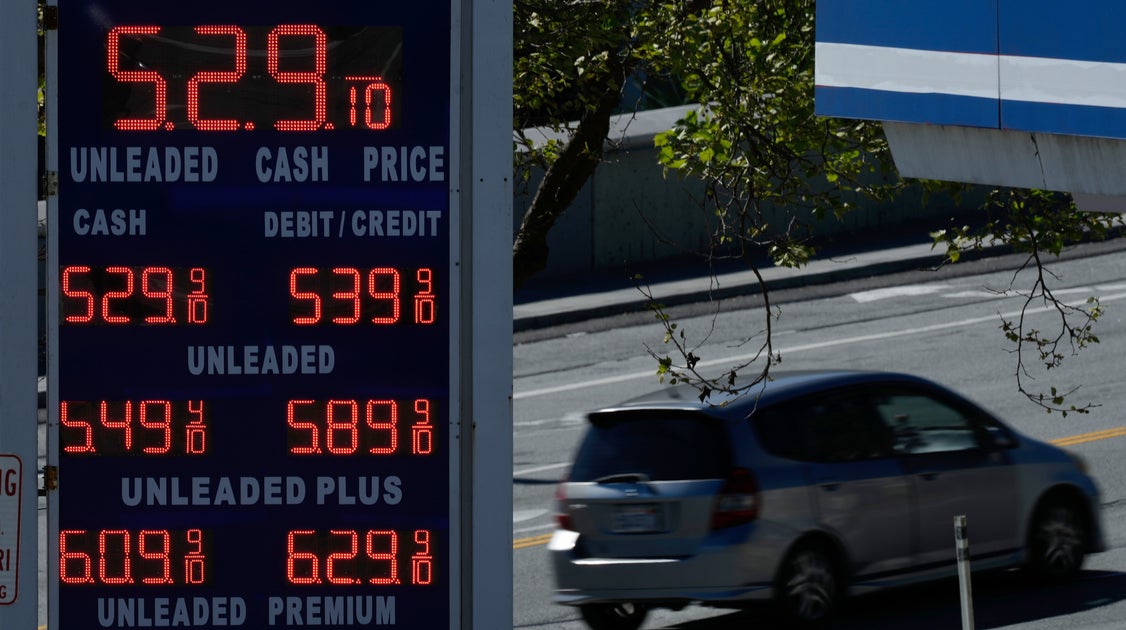
Since the military strikes against Iran began on Feb. 28, crude oil futures have skyrocketed to over $100 a barrel for the first time in nearly four years, before dropping back to around $80 on Monday. The average price of a gallon of regular gas has jumped 19% over the last month, going from $2.93 a gallon this time last month to $3.57 a gallon as of March 11, according to AAA. However, in California, the average price sits at a whopping $5.33 a gallon, well outpacing the rest of the country.

California is often hit the hardest when the global oil supply is disrupted due to several reasons, including the overall higher cost of living, higher gas taxes, environmental regulations and limited refinery capacity.

California law requires a unique blend of gasoline, which is designed to reduce pollution and improve air quality, according to the U.S. Energy Information Administration (EIA). This makes the state particularly susceptible to supply chain disruptions due to the limited number of sources that produce this unique blend. Out-of-state refineries only manufacture this blend to serve the California market, meaning most of the gas used in the state comes from in-state refiners.

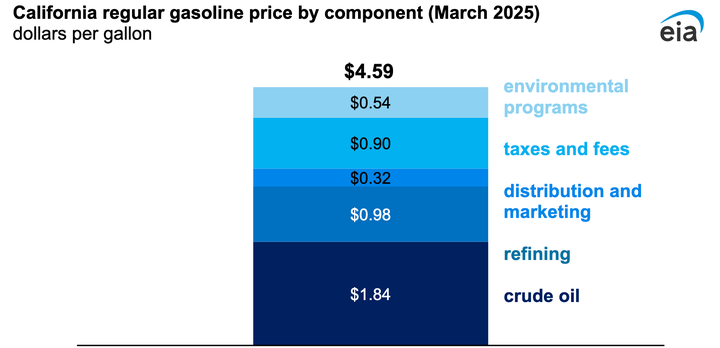
Data from the California Energy Commission (CEC) from March 2025 shows overall environmental regulations in the state contribute to an average rise of 54 cents per gallon.

Geographic limitations, coupled with the state’s demand for the unique blend of gas, also hamper where the fuel can be imported from. The majority of California’s gas is refined in-state, due to the West Coast’s lack of pipeline connections to refineries east of the Rocky Mountains, and pipelines to the Gulf Coast being limited. Of the limited number of refineries that have access to California’s gas markets, very few can meet the state’s fuel blend requirements, according to the EIA.

Higher taxes on fuel also play a major role in the higher-than-average prices in the state, with CEC data showing they contribute to an average rise of 90 cents per gallon. While the federal gas tax is uniform across all states, and contributes roughly 18 cents a gallon to the 90 cents a gallon, the other 72 cents a gallon is made up of the state’s excise tax (60 cents a gallon), state sales tax (10 cents a gallon) and an underground storage tank fee (2 cents a gallon), according to the EIA. The excise tax is by far the highest in the nation, with the average across all states being 28 cents a gallon.

California Gov. Gavin Newsom has asserted the increased prices are solely the fault of President Donald Trump’s decision to take military action in Iran.

“Average gas prices in California have stayed below $5 for nearly two years – until now,” the governor’s office said in a statement on social media. “This is because of Trump’s war with Iran.”

By entering your email and clicking Sign Up, you're agreeing to let us send you customized marketing messages about us and our advertising partners. You are also agreeing to our Terms of Service and Privacy Policy.