Press
‘I count their breaths’: A homeless mother protects her children in Delhi
Images
1 / 19

2 / 19

3 / 19

4 / 19

5 / 19

6 / 19

7 / 19

8 / 19

9 / 19

10 / 19

11 / 19

12 / 19

13 / 19

14 / 19

15 / 19

16 / 19

17 / 19

18 / 19

19 / 19
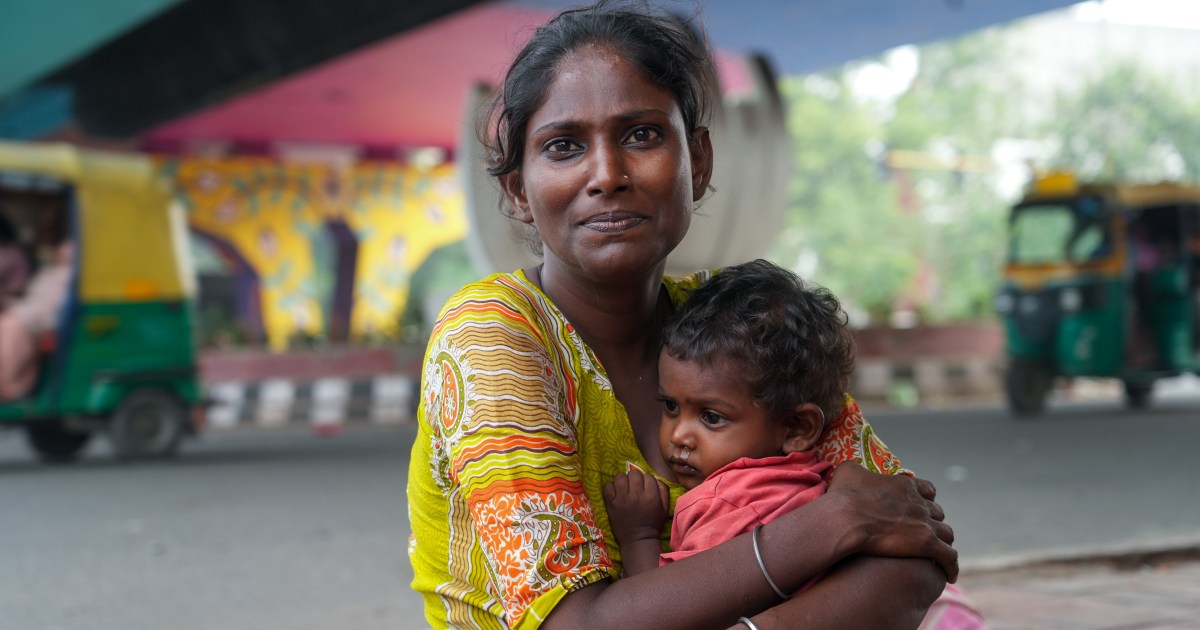
Abida Begum, 40, mother of three

Save

Share

New Delhi, India - It is before dawn on a balmy October morning, and the city is starting to stir. Municipal sweepers raise clouds of dust as they clean the roadside, tea vendors roll their carts into position, and the traffic is starting to pick up. Abida Begum sits on a pavement beneath New Delhi’s Hazarat Nizamuddin flyover, watching over her sleeping children. Her back is straight, her body is still, and her eyes are alert. She hasn’t truly slept in years.

“People like us don't sleep,” she murmurs without looking away. “We just wait for the morning and pray nothing harms our children.”

The family’s few belongings, a torn blanket, an aluminium pot, a few utensils, and a bundle of spare clothes are stuffed into a dust-coated bag, which she places under her head at night to safeguard from thieves. Her children sleep pressed against her. She is their only shield.

Abida’s world is a strip of cracked pavement along a busy four-lane road, surrounded by plastic-sheet shelters and dozens of other families who live there without walls or doors. This concrete footpath has been home since she arrived in Delhi 30 years ago with her mother from the city of Dhubri in Assam, and it is where three of her children were born.

Abida, now 40, grew up begging in the neighbourhood, and she lived with her mother, who died three years ago. Police officials and municipal authorities would frequently harass them, confiscating their belongings to clear the footpath, while strangers would abuse them. When she was about 21, she married a rickshaw puller, hoping for stability. He drank, beat her and eventually abandoned her and their five children.

In the winter, they shiver. Sometimes, nongovernmental organisations bring them food or blankets. In the summer, the heat under the flyover suffocates, and Abida watches for snakes that sometimes find their way to their patch of concrete. All year round, they face harassment by drunken passersby, and she must watch out for possible kidnappers.

“There is no good season for people like us,” Abida says quietly.

Abida and her children start most days by asking motorists at the traffic lights for money or collecting leftover food from nearby eateries. She often skips meals so her children can eat.

“If there's only enough for one plate, it goes to them,” she says, adjusting her shawl. “A mother can stay hungry; children shouldn't.” Years of scarce meals have weakened her body.

When she breastfeeds her youngest child, three-year-old Soni, the only place she can do so with some privacy is in a gap between two concrete pillars as loud traffic and honking horns pass overhead.

The family uses a public toilet, which costs 10 rupees ($0.1) per person. When they can’t afford the fee, they head to a nearby field or hide behind a wall. “There is no dignity left,” Abida says. The public showers charge 20 rupees ($0.20) per person. When they don’t have the money or the queues are so long that they eventually give up waiting, Abida wipes her children’s faces with water and the folds of her sari.

After sunset, she sweeps away dust, plastic bottles, and food scraps from the concrete and spreads a thin sheet for her and the children to sleep on.

Nights are the hardest. Abida sleeps semi-upright, the bulky bag under her head, holding Soni against her chest, five-year-old Hamir and seven-year-old Roshni curled around them. “I count their breaths,” she whispers. “I’m always afraid someone might take them away.”

About 5am on a cold November morning in 2023, Abida and her children were sleeping, wrapped in a thin blanket, when a speeding car crashed into them.

“When I opened my eyes, everything was dust, blood and screaming,” she says. “My two children, Sonia and Amir, were crushed to death in front of me.”

The bodies of five-year-old Sonia and seven-year-old Amir were trapped beneath the vehicle. “I collected their pieces with my own hands,” she says, pressing her hand to her forehead as if trying to push the memory away. “I screamed for help, but it came too late.”

Abida remembers standing frozen in place, blood on her hands, her body shaking. “I just kept looking at them, thinking maybe they were breathing,” she recalls quietly. “Maybe I was wrong. Maybe they will wake up.”

Abida later heard from bystanders and police officers that the five people inside the car had been drinking. “People told me the smell of alcohol was strong,” she says quietly. “Maybe that’s why they lost control.”

Abida followed the ambulance in an autorickshaw to the hospital morgue. She waited silently for hours to see her children one last time. Then she left, knowing she had no place to bury her children. “I still hear that sound every night, the crash, the screams,” she adds quietly, holding Soni close to her chest.

“They used to fall asleep holding my fingers in my lap,” she recalls, steadying her breath and looking at her hands.

“Since that day, I feel depressed, as if a part of my body was taken away.”

Abida and her family continue to live on the same pavement where her children were killed because they have nowhere else to go.

“What home do we have?” she asks. “We have no land in the village, no job here. If we move, the police chase us away. This road is the only place where we are not pushed.”

In the cool breeze before sunrise, Abida sits wrapped in a worn shawl, Soni lying in her lap. Roshni nestles her head against her mother’s shoulder, and Hamir watches municipality workers clear the pavements. Abida rubs their hands between her palms to warm them.

A speeding truck passes, and the children flinch.

“Nothing will happen,” she murmurs, kissing Roshni’s hands.

As evening falls, Abida’s children run around laughing, approaching cars for coins and biscuits. But when darkness returns, fear and restlessness take over again. At night, Abida watches the road while her sleeping children cling to her. Sometimes they wake up crying when a vehicle hurtles past.

“When trucks honk, my children wake up screaming,” Abida says. “The noise never stops.”

Abida prays that the pavement won’t be her children’s future and that they will have an education.

“I lost two children, but I have to live for the three who are left,” she says, her voice shaking. “I’ll do anything to keep them safe.”

At night, as the traffic roars overhead, Soni is jolted awake and clings to her mother’s blouse. Abida pulls her close and hums softly until the girl drifts back to sleep, Roshi and Hamir asleep beside them.

In a city that has given them nothing, Abida cannot promise her children safety or sleep, but only her presence. On this strip of concrete, her love is the only home her children know.

This story is part of a miniseries, Mothering on the Margins, exploring how five women around the world grapple with impossible circumstances to raise their children.

Read more from the series:

'I have fought for Aaron': A Ugandan mother confronts disability and stigma