huffpost Press
Supreme Court To Hear Case That Is ‘Literally Life And Death’ For Many People
Images
1 / 3

2 / 3

3 / 3
U.S. law allows anyone who steps foot in the United States to pursue a claim for asylum ― full stop.

So, should American border guards be able to act like linebackers at ports of entry, turning back anyone who approaches expressing a fear of returning home, and preventing those asylum claims by force?

That’s the issue coming in front of the Supreme Court on Tuesday in Noem v. Al Otro Lado, as the justices consider whether to green light an immigration policy initiated by President Barack Obama’s administration, and systematized by Donald Trump in his first term.

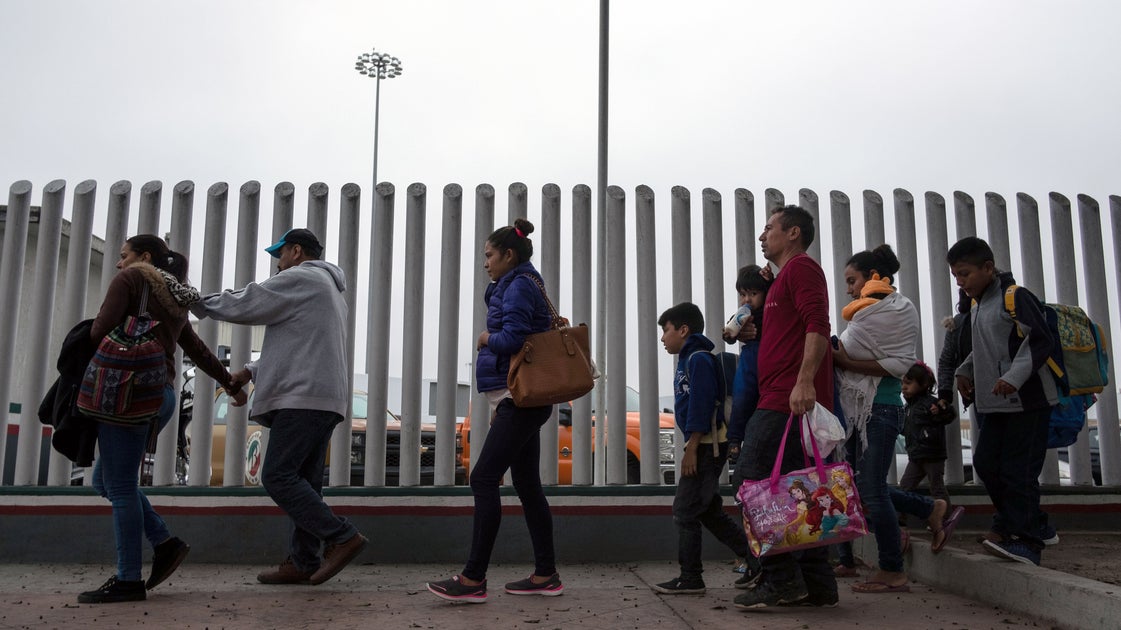
Under the so-called “metering” policy, migrants who arrived at ports of entry along the southern border, where historically they would have been allowed to claim a fear of persecution in their home country and begin the process of pursuing asylum in the United States, were instead turned back into Mexico regardless of the merits of their case ― without any record of their encounter, nor a date to return and try again.

The metering, or “turnback,” policy, ended during the Biden administration. A district court ruled against the policy in 2021, and the Ninth Circuit Court of Appeals again ruled against it in 2024.

Other policies aimed at restricting the number of people claiming asylum at the border ― from the “Remain in Mexico” and “Title 42” policies to Biden-era crackdowns on asylum rights ― have had a similar effect. And Trump has all but eliminated asylum rights at the border in his second term, amid his ongoing campaign against immigration in general, including attempts to crack down on migrants in the United States legally.

Now, Trump wants the leeway to pursue his original turnback policy again. Last year, he successfully petitioned the Supreme Court to take up the case over metering. The justices will be asked to determine whether someone arriving at a border port of entry and presenting their case to officials — even if they are stopped by those officials from crossing — allows them to make an asylum claim.

Advocates point out that the turnback policy previously led to thousands of people with arguably valid asylum claims being stranded in Northern Mexico, where they often faced kidnapping, rape and murder.

“We know dozens, hundreds of cases where people were assaulted, kidnapped, tortured, some were murdered, because they were waiting to seek asylum, and they wanted to try to do it in the way that U.S. law sets out as the lawful way,” Rebecca Cassler, senior litigation attorney for the American Immigration Council, told HuffPost. “They didn’t want to cross the border away from a port – they were trying to follow the law, so they were waiting to see if they could get a chance to come in, and they suffered greatly for it.”

Cassler, who will be one of the attorneys representing asylum seekers at the high court on Tuesday, told HuffPost the Trump administration was looking for a “blank check” to bring the policy back in the future.

“While this case focuses on just one defunct policy, we have no doubt that the administration is seeking a decision that will give them even more leeway to restrict the rights of people seeking asylum,” Melissa Crow, director of litigation at the Center for Gender and Refugee Studies and another of the litigators set to appear in court Tuesday, said at a press briefing last week.

“For people fleeing persecution, the stakes are literally life and death.”

Lower courts have ruled that someone seeking asylum at a border port of entry has technically “arrived in” the United States for the purposes of asylum law, even if they’ve been forcibly prevented from stepping foot onto U.S. soil, and that as a result, the turnback policy violates the law.

Immigration nonprofits representing asylum seekers have pointed to the majority ruling in the Ninth Circuit of Appeals, from October 2024, in which a split court found that “the phrase ‘arrives in the United States’ encompasses those who encounter officials at the border, whichever side of the border they are standing on.”

The Trump administration disagrees. “In ordinary English, a person ‘arrives in’ a country only when he comes within its borders,” the administration argued in a January brief. “A person does not ‘arrive in the United States’ if he is stopped in Mexico.”

It added that the appeals court ruling “deprives the Executive Branch of an important tool for addressing border surges and preventing overcrowding at ports of entry.”

But more broadly, the case concerns what Cassler described as a century-old legal principle that people arriving at U.S. borders ought to have their cases evaluated by border officials ― a principle that’s written into modern immigration law.

“Our asylum commitments were created within the context of ports always working this way,” Cassler said.

That principle was bolstered by an infamous asylum-related incident during the Holocaust, which has come to be seen as a humanitarian failure. In 1939, over 900 people, almost all Jews fleeing Nazi persecution, bought passage on the MS St. Louis, a ship headed for Cuba, which ultimately sought refuge in the United States, coming close enough for those on board to see Miami, although passengers were not allowed to leave the ship. The United States turned the refugees away, and 254 were ultimately killed in the Holocaust.

In 2012, then-Deputy Secretary of State William J. Burns noted that a photo of the St. Louis was hung in the State Department refugee bureau’s front office ― a symbol of the importance of accepting refugees. He also acknowledged the United States’ failure to act: “Our government did not live up to its ideals. We were wrong,” Burns said in official remarks at the time.

The humanitarian group HIAS, which was founded in 1903 as the Hebrew Immigrants Aid Society, cited the story of the St. Louis in a February amicus curiae brief.

“Informed by the suffering of the St. Louis passengers, Congress codified asylum protections at U.S. borders and created orderly procedures to assess asylum claims from people who reach a port of entry and to grant refuge to those who risk persecution if turned away,” the group wrote.

“The policy here flouts the law Congress enacted and wrongly turns back the clock to a period when people fleeing persecution were forced to face arbitrary procedures, crushing uncertainty, and prolonged sojourns in dangerous conditions in a legal no man’s land.”

By entering your email and clicking Sign Up, you're agreeing to let us send you customized marketing messages about us and our advertising partners. You are also agreeing to our Terms of Service and Privacy Policy.