yahoo Press
Should I invest in gold in 2026?
Images
1 / 11
2 / 11

3 / 11

4 / 11
5 / 11

6 / 11

7 / 11
8 / 11

9 / 11

10 / 11
11 / 11
Some offers on this page are from advertisers who pay us, which may affect which products we write about, but not our recommendations. See our Advertiser Disclosure.

As you work and save for your future, you're likely looking for ways to achieve financial independence faster. Investing is key to building long-term wealth, but the steep ebbs and flows of the stock market can make anyone wary, so it's no surprise that more and more investors are turning to gold (GC=F).

But is investing in gold a good idea? It's a common question. Gold can play an important role in your investment portfolio, but experts agree that it should be part of a larger investment strategy.

This guide explores why gold is a solid investment, its risks and benefits, and the percentage of your portfolio that should be invested in gold.

Unlike stocks, which allow you to buy pieces of businesses, gold is a commodity. It has intrinsic value and a finite supply. This scarcity is what gives gold a unique role in the global economy.

When economic conditions are uncertain or investors are nervous about geopolitical issues, they typically turn to gold as a store of value to preserve their purchasing power.

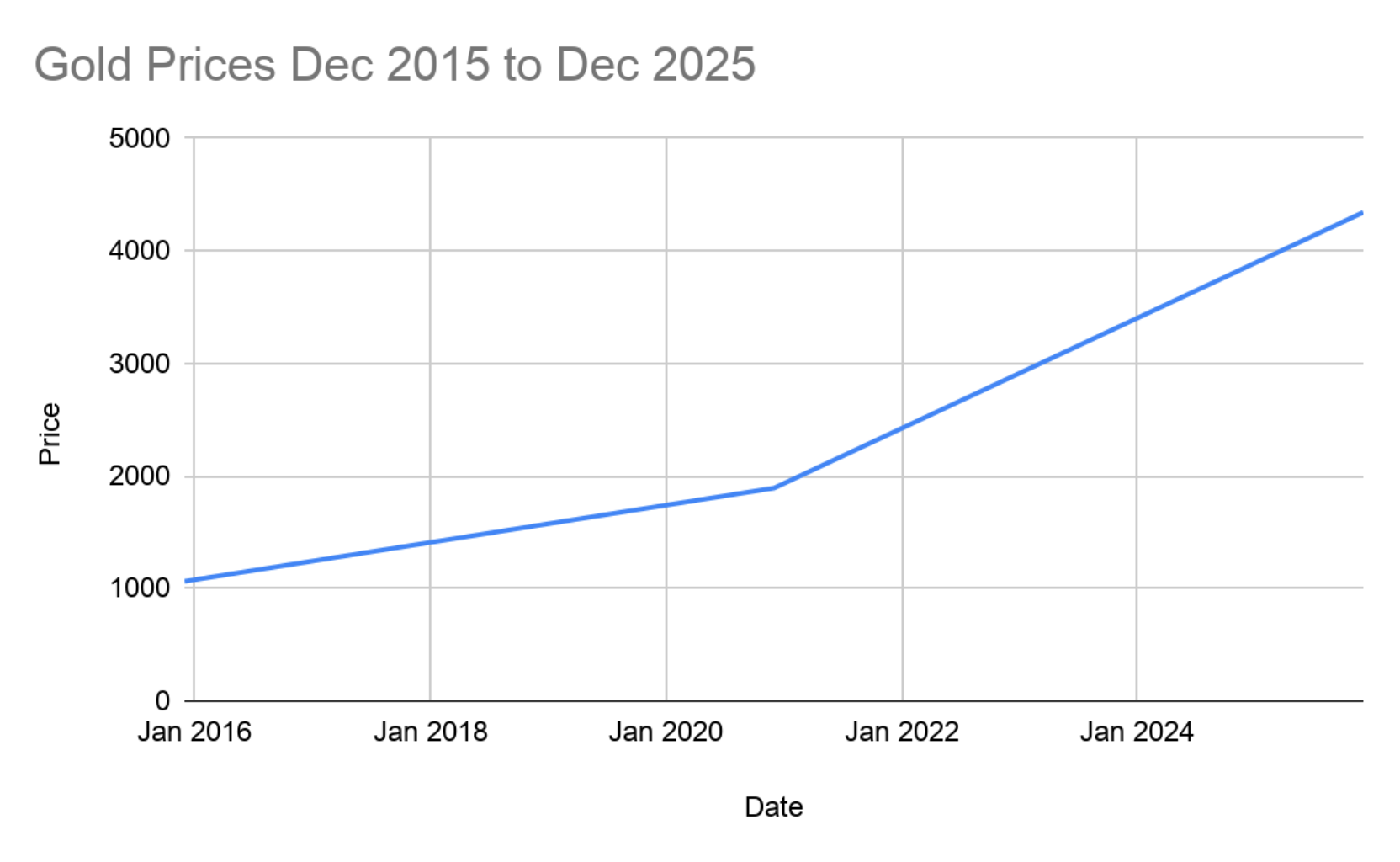
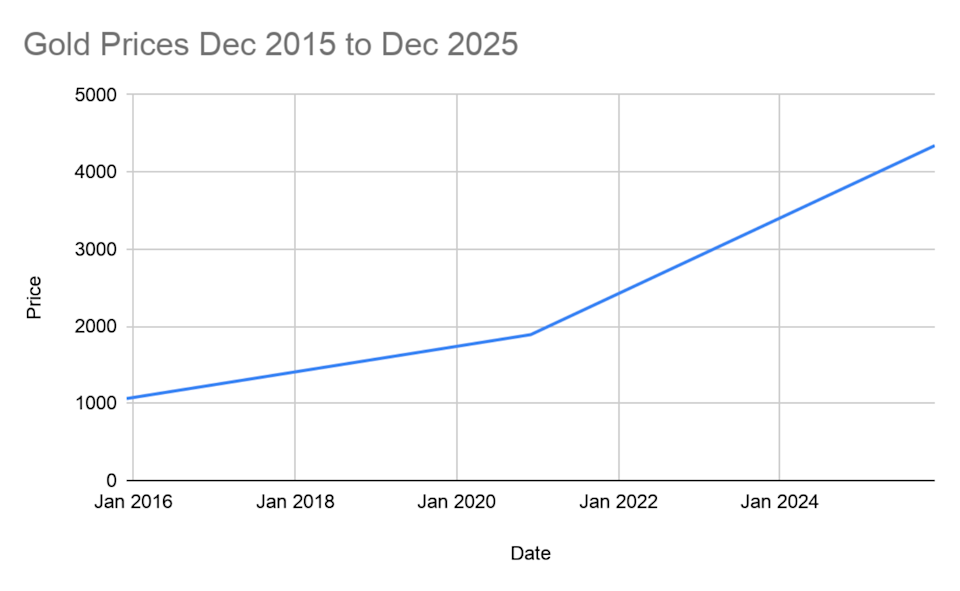
For years, gold prices were relatively stagnant. But major economic events, including changes to U.S. government policies, inflation, and worldwide political tensions, drove a steep increase in gold prices over the past decade. Between December 2015 and December 2025, its price went from $1,062 to $4,341 per ounce.

Learn more: How much gold would $1 million buy at different points in history?

Investing in any asset carries some level of risk. Before investing your hard-earned money in gold, weigh the pros against the cons:

Hedge against inflation: Inflation, or an increase in prices for goods and services, can erode the value of your savings and retirement fund. As prices rise, your money doesn't go as far. However, gold prices have risen steadily alongside the cost of living, making it a hedge against rising inflation.

Historical performance: Historically, gold has performed well during periods of economic uncertainty, including inflation spikes, recessions, stock market declines, or high levels of unemployment. During these periods, investors turn away from traditional investments like stocks and move their money into investments they view as “safer,” such as precious metals. As a result, gold holds value — and even increases — during uncertain periods.

Portfolio diversification: Financial experts warn against putting your money into one type of investment or one sector. Gold's price is largely independent of the stock market, so having some money in gold can protect your portfolio from losses if your stock investments decrease.

Read more: Investing in gold? Here’s how to avoid a tax hit.

Lack of liquidity: Gold investments, particularly physical gold coins or bars, are less liquid than other investments. If prices take a downturn and you need cash, you'll have to sell at a loss, and you may have to pay premiums or fees.

Not income producing: Unlike some investments, such as stocks or bonds, gold isn't an income-producing asset, meaning you won't earn dividends or interest. Gold just sits there, and you can only get money from your investment by selling your gold holdings for more than you paid.

Performance flags the stock market: While gold's price has dramatically increased, its performance still flags that of the stock market. Investing primarily in gold could cause you to lose out on much higher returns.

Learn more: Gold IRA vs. physical gold: Which is the better investment?

In the short term, gold has occasionally outperformed stocks and bonds. But over the long-term, the stock market puts gold in the dust.

Consider the performance of gold and stocks over the past 30 years. From the end of 1985 to the end of 2025, gold's price went from $327 to $4,341 per ounce. If you invested $10,000 in gold in 1985, it would be worth $132,747 today.

However, if you invested $10,000 in the S&P 500 in 1985, your money would now be worth $323,000. And if you invested $10,000 in the Nasdaq, you'd have $715,000. Sticking only with gold would cost you anywhere from $170,000 to $582,000.

Learn more: What would happen if all the gold in the world were sold tomorrow?

Given the above information, you may still be considering putting some of your money into gold. In general, experts say a good guideline is to put no more than 15% of your total investment portfolio into gold. The remainder should be a mix of stocks, exchange-traded funds (ETFs), mutual funds, or bonds, based on your risk tolerance, age, and financial goals.

Gold can give you security, but you don't want to spend all of your money securing your investments. Instead, a little bit of money in gold can give you peace of mind and keep you safe during periods of uncertainty.

Learn more: How to start investing: A 6-step guide

Looking ahead to the rest of 2026, experts agree that gold's outlook is strong. Analysts with JPMorgan expect its price to exceed $5,000 per ounce by the end of the year. And though gold's price dipped in March, analysts expect it to recover.

The combination of inflation concerns and worries about the conflict in Iran continues to make gold an attractive investment.

Yes, gold is generally considered a safe investment, meaning it usually holds value or even increases in price during economic downturns. However, its price can be volatile in the short term.

Financial experts recommend putting 5% to 15% of your total investment portfolio into precious metals like gold. This allocation gives you some protection from market volatility while allowing you to invest in other securities to build long-term wealth.

Rather than thinking of your investments as an either/or choice, consider a blend. Gold can complement a larger investment portfolio of stocks and bonds, diversifying your investment and reducing overall risk.

Learn how to invest in gold by considering gold's strengths, historic behavior, and the pros and cons of physical gold versus gold mining stocks and ETFs.

For investors looking to diversify beyond stocks and bonds, gold is a popular choice. Here's what beginners need to know.

Gold has the same high-level risk as any investment. Would-be gold investors should understand the risks associated with price, speculation, opportunity cost, and fraud.

The two primary gold prices investors should know are spot prices and gold futures prices. Learn the difference, the historical price of gold, and the current dynamics.

If you had $1 million in 1900, you could buy 53,000 ounces of gold. Today, that amount would be worth $278 million. See how gold prices have changed over time.

Gold and silver prices have been on a tear, with silver prices increasing by more than 100% year to date. Experts weigh in on what could be causing these record highs.