yahoo Press
China’s Official Calm Belies a War Battering Small Factories
Images
1 / 6
2 / 6

3 / 6

4 / 6
5 / 6
6 / 6
(Bloomberg) -- When China’s Premier Li Qiang stood before global executives in Beijing last weekend pledging stability for his nation’s economy, toy factory manager Huang Shan had just laid off half his workers — undone by a war that’s rapidly reshaping the outlook for millions of smaller firms.

“All I want is to run a small business just to support my family with some steady income,” said Huang Shan, who’s slashed his production staff in the eastern province of Zhejiang to about 100 employees since the start of the Iran war. But now “the international environment is too harsh,” he said.

In public — including at the China Development Forum — top leaders have so far sidestepped the war’s toll on China, leaving it to senior diplomats to hold calls urging deescalation. The hit to the broader economy has also been cushioned by the nation’s vast strategic oil reserves and its decade-long push into renewable energy.

But the small and medium sized firms that are vital engines of employment in the world’s second-largest economy are nevertheless seeing their input costs surge. And as the war drags on, that risks adding to policymakers’ challenges this year.

The gap between Beijing’s studied calm and the gathering pain on China’s factory floors was on full display at the Boao Forum that began Tuesday — an annual confab in the southern island province of Hainan sometimes referred to as China’s Davos.

At a keynote speech on Thursday, China’s No. 3 official Zhao Leji framed China as a land of opportunity for investors while making only veiled references to global instability. Official panels discussed innovation and regional cooperation, even as the Strait of Hormuz remained effectively shuttered to the world’s most vital energy shipments.

A Western diplomat attending the event described the atmosphere as dissonant with reality. Beijing, the diplomat said on condition of anonymity, appears determined to keep public debate about the war muffled ahead of the anticipated summit between Presidents Xi Jinping and Donald Trump. That tête-à-tête is now expected in mid-May, delayed over a month by the Iran hostilities.

Away from the speeches and the panel discussions, a punishing reality is taking hold on the assembly line.

“I haven’t encountered such a difficult situation in more than a decade,” said Chen Yubing, manager of a factory in the eastern province of Jiangsu that makes polyester and nylon fabric.

After Trump’s tariff hikes on China slashed his profits by a third last year, Chen is now contending with a 40% jump in the cost of yarn and chemicals. Unable to fully pass those expenses on, he’s raised prices by only a few percentage points. If costs remain elevated, his 90-person workshop may be forced to suspend operations entirely, he said.

Analysts expect this kind of squeeze to affect a broad swath of China’s manufacturing.

Producer prices are now forecast to rise 0.3% this year, a Bloomberg survey of economists conducted over the last week showed. That marks a sharp reversal from the 1% contraction expected before the US and Israel started the conflict. But with consumer price projections remaining modest, that would mean a tightening vice on profit margins for managers like Chen and Huang.

The burden is seen falling hardest on consumer-facing industries that rely heavily on oil-related materials — a sector that’s already been hampered by China’s multi-year property market downturn and entrenched deflationary pressures.

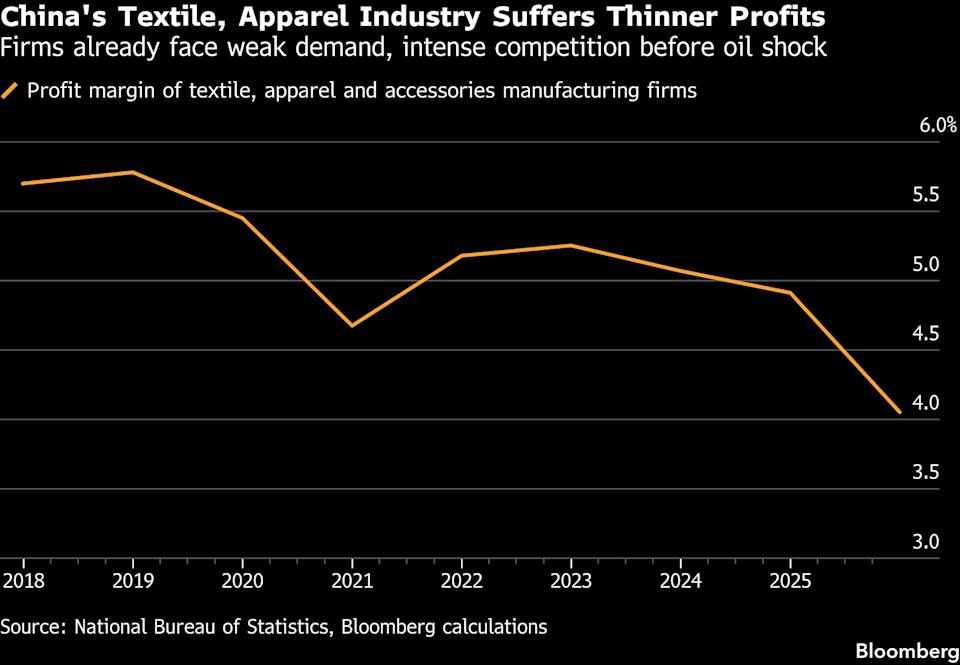
Profit margins for China’s textile and apparel industry fell to 4.1% in 2025, the lowest in data going back to 2017. The plastic and rubber sector saw margins erode for two consecutive years to settle at 5.3%. These industries are dominated by small, private firms that are far more vulnerable to external shocks than the state-owned giants responsible for primary energy production.

“The rise in raw material prices is essentially a redistribution of profit,” said Jacqueline Rong, chief China economist at BNP Paribas SA. While upstream companies can pass on costs, “the downstream sector is usually the weakest in terms of its ability to pass the full weight of rising costs onto the consumer.”

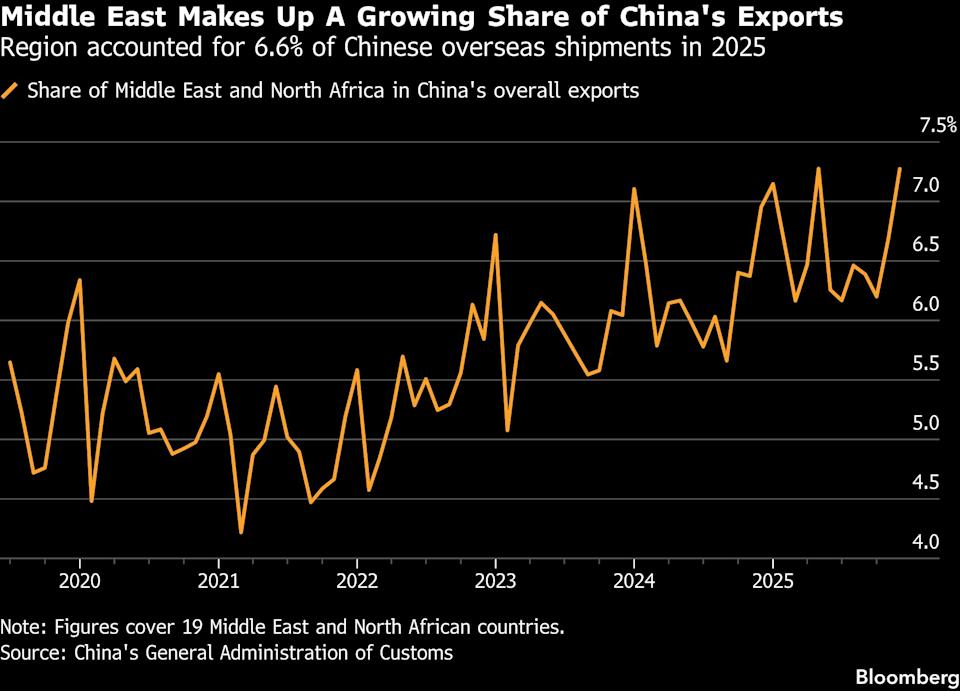
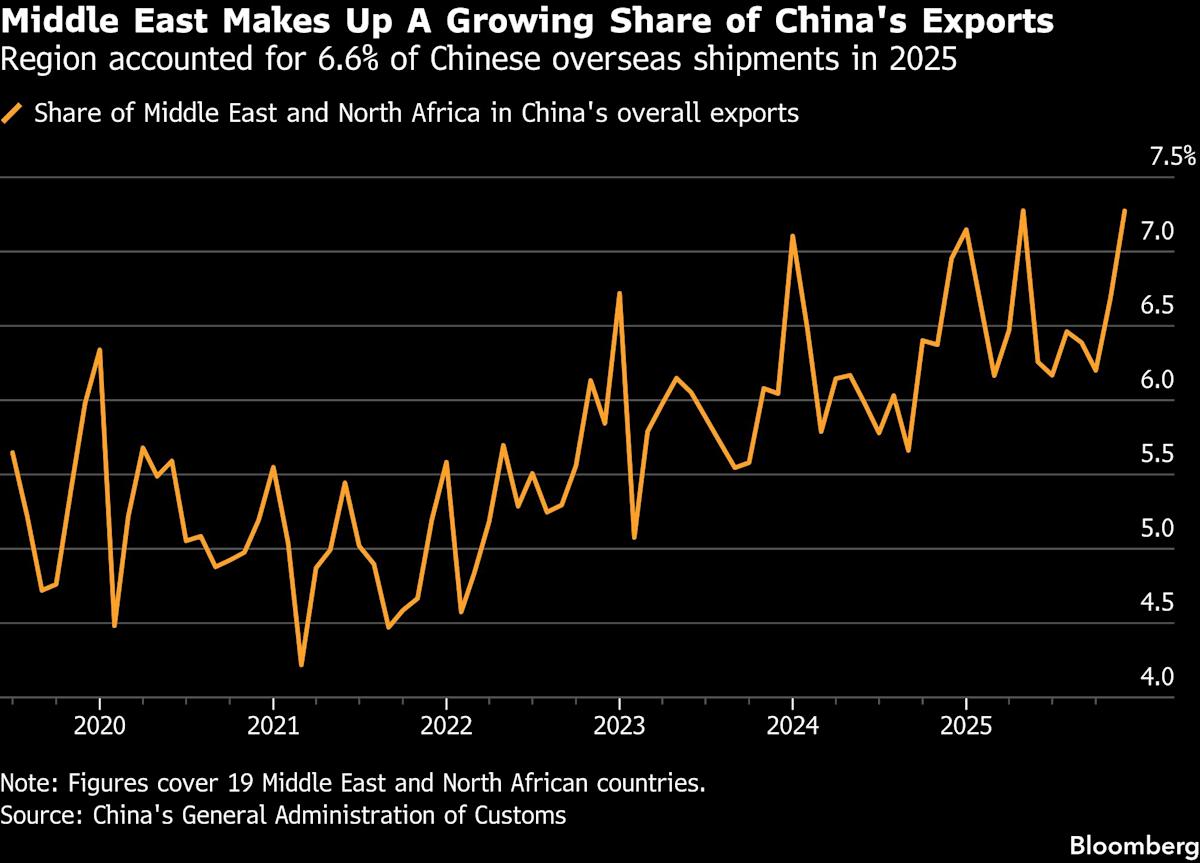
The war has also disrupted one of China’s most promising export markets.

Andre Huang, a sales manager for a home-cleaning tool exporter in Zhejiang, said his company has halted production for a Middle Eastern client, uncertain if shipments can navigate the regional blockade.

His factory, which produces mops and brooms, is currently relying on plastic pellets purchased when prices were low — a buffer that will eventually expire, exposing the firm to a potential 40% cost surge.

The disruption in demand extends beyond the Middle East. Janie Han, who owns a company exporting fabric to Europe, said she had only received one order since the end of the Lunar New Year in mid February because clients were hesitant to place orders amid price volatility. She’s now weighing whether to keep the business going, given the thin profit margin and uncertain outlook.

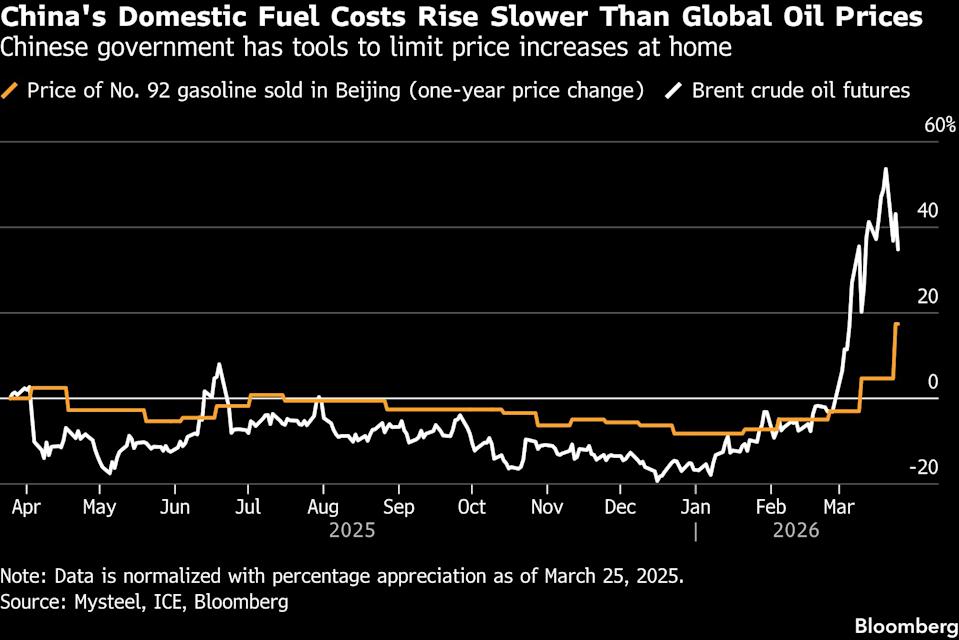
The government has tools to blunt the blow of the energy shock. The National Development and Reform Commission, China’s top economic planning agency, announced measures on Monday to cap domestic gasoline price increases — the first time it has used such price controls since the current oil pricing mechanism was introduced in 2013.

Goldman Sachs Group Inc. analysts estimate that only about 6% of China’s total energy consumption is directly exposed to Strait of Hormuz disruptions, thanks to a diversified energy mix and supply routes that bypass the Persian Gulf altogether. Historically, a 1% rise in Brent crude has translated to only a 0.3 percentage point increase in gasoline prices at the pump, Goldman says.

Some sectors stand to benefit from the higher energy prices, such as coal miners and domestic oil drillers. China’s dominance in electric vehicles, solar panels and other green-energy products could generate a surge of exports as countries rush to reduce their exposure to Middle Eastern oil. Meantime, the global boom in AI continues to drive demand for Chinese-made components, providing another layer of insulation.

But the net result risks become a K-shaped economy, with one part contracting and another accelerating. Lin Guijun, former vice president of the University of International Business and Economics, pointed out the divergence on the sidelines of the Boao Forum.

For oil-intensive manufacturers, higher costs will inevitably shrink output and weigh on employment, he said. For others, the conflict could be a grim windfall.

“Alternative energies will prosper,” he said. ”Solar panels will be more useful, and the coal miners will be very happy.”

— Nectar Gan, Yujing Liu, Daniela Wei, Colum Murphy, Lulu Shen, Cynthia Li, Qizi Sun, Dan Murtaugh

--With assistance from Lulu Shen, Cynthia Li, Qizi Sun and Dan Murtaugh.

(Updates with Zhao Leji’s Boao speech.)

More stories like this are available on bloomberg.com

©2026 Bloomberg L.P.