Press
Is there such a thing as good screen time for under fives?
Images
1 / 9

2 / 9
3 / 9
4 / 9

5 / 9
6 / 9

7 / 9

8 / 9

9 / 9
Parents should aim for no more than one hour of screen time per day for children under the age of five, a new report from the Department of Education has recommended.

And for under twos, the advice is to avoid screens except for shared, interactive use.

But for many parents struggling to manage work, household chores, and other siblings - and even their own screen time - this might seem an impossible, unrealistic task.

So, how do you manage screen time, why does it have a bad impact on children, and what steps can you take to mitigate the problem?

The term "screen time" covers all types of screen use, including computers, tablets, mobile phones, and televisions.

The government has previously said about 98% of children are watching screens on a daily basis by the age of two.

Parents should lead by example, the guidance recommends, as children's brains are "like sponges - they'll copy your screen use habits" and encourages being present with children. Try and put your own phone away as much as possible.

It is difficult to get away from screens in our daily lives, and whilst it is understandable to reach for a device sometimes, it is important to try other activities or stop using screens at all when possible.

Try to keep eating and sleeping free from digital distractions, for example:

Another tip is to treat children as conversational partners even when they're babies, Danielle Matthews, a professor of psychology at University of Sheffield, told the BBC. It is a way of getting that valuable interaction with your child without having to make new time.

Whether it is going on a bus trip or just hanging out the washing, talk to them about what you are doing together, she explained.

"Studies suggest it helps to slow the pace down to allow little children to take their turn in the conversation. Responding to them with language that is tuned in to their interests can really help them to learn to talk."

Welcoming the guidance, she said: "Parents have got a lot going on and they just want some help with their everyday life and some information that is evidence-based and helpful".

Parents should be realistic and use their own judgement when deciding on what kind of screen time their children have, but watching together and discussing is clearly better than solo watching, Matthews adds.

The guidance says time limits shouldn't apply in the same way for screen-based assistive technologies used to support children with special educational needs and disabilities.

The NSPCC charity offers some practical tips for parents of young children, including supervising use, checking content beforehand, and talking about safety directly.

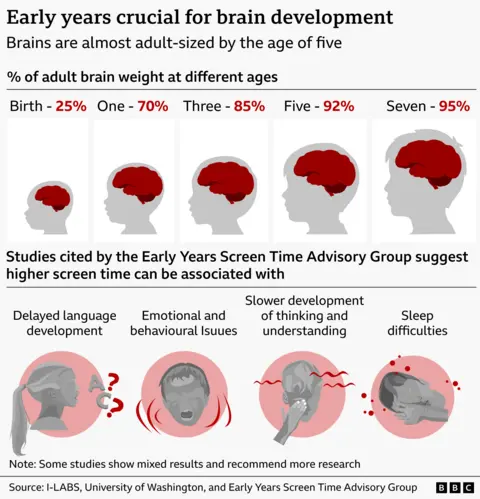
The impact on children's social skills depends on what stage of development they are at, but according to the government report, 90% of brain growth happens before age five.

A large amount of screen time is linked to negative effects on a child, and can affect social, emotional, language and brain development, sleep, eyesight and healthy weight.

Children learn their most crucial skills in the first year of their lives, which makes this period an important time for them to get as much interaction with humans as possible.

Separate government research published earlier this year showed that children with the highest screen time - around five hours a day - could say significantly fewer words than those at the other end of the scale who watched for around 44 minutes.

Stepping away from the connected world to engage with your children can also be good for your own mental health, Prof Sam Wass from the Institute for the Science of Early Years at the University of East London told the BBC's Today programme.

Evidence shows that slowing down to the pace of a young child, even for a couple of minutes, can help adults regulate too, according to Wass.

But not all screen time is the same. Watching screens with an engaged adult is linked to better cognitive development than solo use, according to the guidance.

"It's all about balance. We know that too much sedentary screen time can have a negative effect on children's development," speech and language therapist Janet Cooper previously told the BBC's Tiny Happy People website.

"Your brain has a built-in 'seeking system'," she explained. "It's activated by the people around you."

"If young children are spoken to one-to-one and people show them interesting things, that develops the seeking system to make them explore and make the most of the world around them," Cooper said.

This "seeking system" is key to our motivation and desire to explore and understand from an early age, and it is learnt by interacting with humans.

Screen time should support, not replace, connection, conversation and play, according to Kate Morton, senior head of commissioning for CBeebies.

She said the new guidance reflected "what many families already know; that it's not about getting it perfect, but about making informed choices that work for them".

The Department for Education recommends that video content and TV shows for under-fives should be:

Fast-paced content is defined as "over-stimulating social media-style videos" in the government guidance.

Wass says this kind of content creates a fight-or-flight response in a child's brain.

"If stuff is coming at us too fast, something called the fight-or-flight stress system kicks in, where your heart starts beating faster and you start to get a lot of energy released to your muscles," Wass said.

"Programmes like Hey Duggee, Puffin Rock, Bluey and Ranger Hamza's Eco Quest are intentionally calm, easy to follow and repetitive, with clear storytelling and relatable moments that help children make sense of the world around them", Morton said.

Parent-facing content like Cbeebies Bedtime stories also encourage "interaction, imagination and shared viewing between children and their loved ones around them", she added.

The guidance is the first evidence-backed, practical advice issued by the government, but ministers say it will be kept under review as more evidence emerges.

"This is still quite an unknown area in lots of respects and we've taken a precautionary approach," Education Secretary Bridget Phillipson said.

Visit Cbeebies Parenting for more information.

For more advice around screen time check out the Best Start in Life website here.

Parents say new government guidance on restricting children's screen time has to be "realistic".

Parenting experts share their tips on how to keep children's screen time under control.

Animal welfare campaigners welcome a "pivotal moment" in the move towards a ban on trail hunting.

GP says long waits for support mean some doctors feel forced to prescribe medication outside of guidelines.

The Music Boutique founder said the lender had "stopped the clock" for the school's mounting arrears.