yahoo Press
Why Income Investors Keep VTV as a Core Portfolio Anchor in a Turbulent 2026
Images
1 / 5
2 / 5

3 / 5

4 / 5

5 / 5
Vanguard Value ETF (VTV) is up 2.76% year-to-date, outpacing the S&P 500’s 5.4% decline and Nasdaq 100’s 6.6% drop. Top holdings include JPMorgan Chase (JPM) with a 2% dividend yield and $57.05B in FY2025 net income, Johnson & Johnson (JNJ) with 52% appreciation over the past year, and UnitedHealth Group (UNH) which has fallen 46.8% due to rising medical costs and regulatory pressures, highlighting the risk of passive value trap exposure in index-based funds.

Value stocks are outperforming growth during market weakness because VTV’s defensive positioning in financials, healthcare, and industrials with lower multiples provides downside cushioning when the market reprices away from expensive growth companies.

Have You read The New Report Shaking Up Retirement Plans? Americans are answering three questions and many are realizing they can retire earlier than expected.

Retirees and income-focused investors have long used Vanguard Value ETF (NYSEARCA:VTV) as a core portfolio anchor, drawn to its dividend income, lower volatility relative to growth funds, and near-zero cost structure. With the broader market under pressure in 2026, that positioning has paid off: VTV is up 2.76% year-to-date while the Nasdaq 100 has dropped 6.6% and the S&P 500 has fallen 5.4% over the same period.

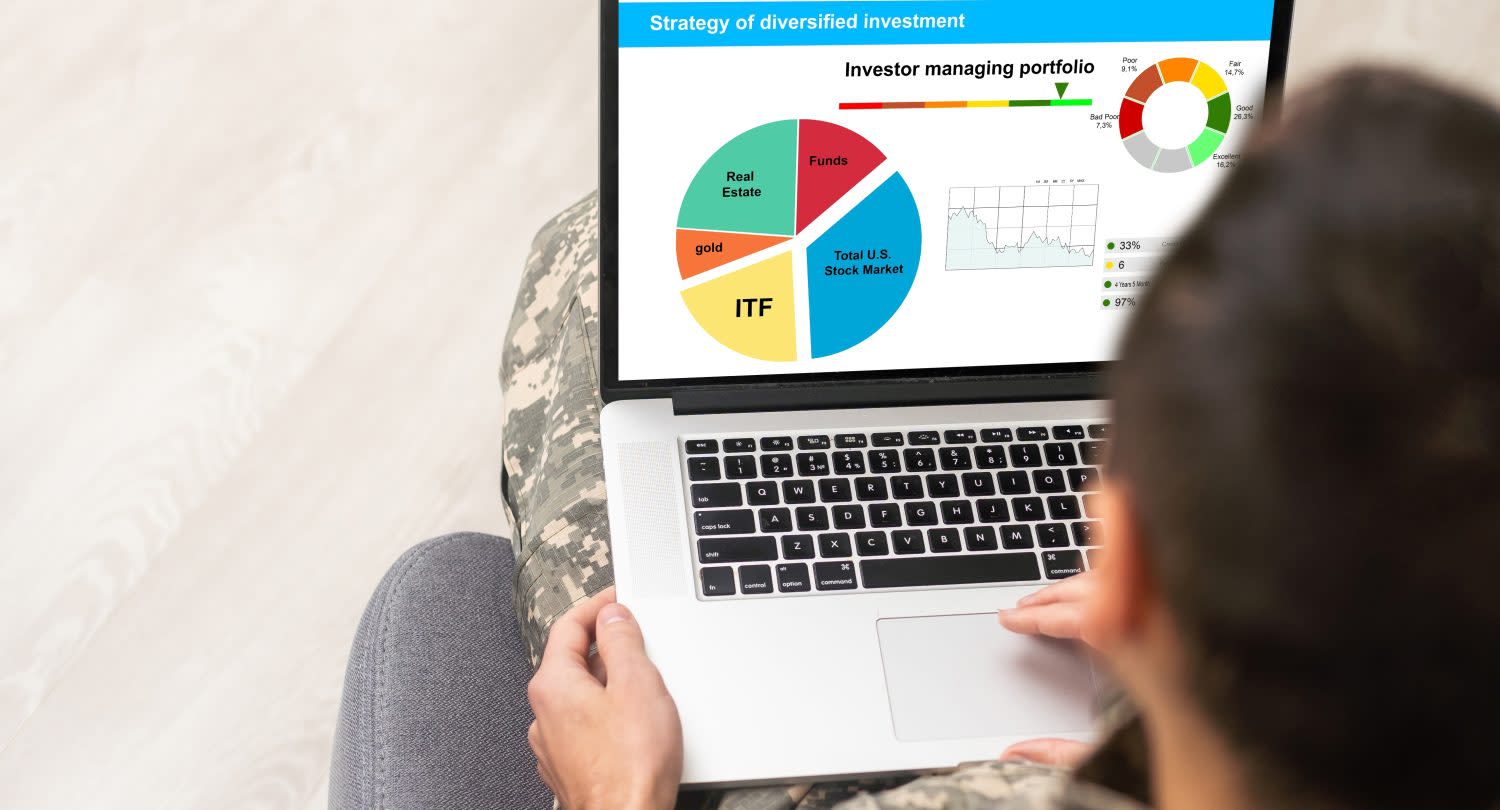
A person reviews large-cap value stock data and Vanguard ETF performance on a MacBook Pro.

VTV tracks the CRSP US Large Cap Value Index, which uses a multi-factor scoring system combining price-to-book, forward earnings, historical earnings, dividend yield, and sales-to-price ratios to identify stocks trading at a discount to intrinsic worth. The fund holds over 300 companies, carries a 0.03% expense ratio with a dividend yield near 2%. Its net assets stand at roughly $238.5 billion, making it one of the largest pure-value ETFs available.

Have You read The New Report Shaking Up Retirement Plans? Americans are answering three questions and many are realizing they can retire earlier than expected.

The return engine is straightforward: own mature, cash-generating businesses at below-market multiples, collect dividends, and benefit as valuations normalize. No options overlays, no leverage, no synthetic exposure.

The sector mix reflects this philosophy. Financials lead at 18.1%, followed by Healthcare at 15.5% and Industrials at 14.6%. Those three sectors account for roughly 48% of the portfolio. Consumer Staples and Energy round out the defensive tilt, while Information Technology sits at just 10%, a sharp contrast to growth funds where tech often exceeds 40%.

On Bogleheads forums and Reddit investing communities, VTV is frequently cited as the "value half" of a barbell strategy paired with Vanguard Growth ETF (VUG) or used alongside Vanguard S&P 500 ETF (VOO) for investors who want to tilt toward cheaper valuations without abandoning diversification.

Over the past decade, VTV returned 207% while the Nasdaq 100 returned 436%. Growth won decisively. Over five years the gap narrows: VTV gained 66% versus the Nasdaq 100's 82%. Investors who held VTV gave up meaningful upside but experienced far less volatility during sharp corrections.

The top holdings illustrate both the appeal and the complexity of value investing. JPMorgan Chase (NYSE:JPM), the fund's second-largest position at 2.98%, trades at a trailing P/E of roughly 15x with a 2% dividend yield and delivered FY2025 net income of $57.05 billion. Johnson & Johnson (NYSE:JNJ) posted 52% price appreciation over the past year, one of VTV's standout contributors.

UnitedHealth Group (NYSE:UNH) illustrates the value trap risk in any index-based strategy. UNH has fallen 46.8% over the past year, weighed down by a surging medical care ratio, a costly cyberattack, and DOJ scrutiny. Because VTV holds it as a passive constituent at 1.03%, there is no mechanism to exit a deteriorating position. The index rebalances periodically, but not in response to fundamental deterioration.

AbbVie (NYSE:ABBV) adds a different dimension: a 3.2% dividend yield and a 5.5% dividend increase in 2025, but a trailing P/E distorted by IPR&D charges and negative book value from its acquisition history. Its forward P/E of 14x suggests the business is cheaper than the headline multiple implies.

Structural growth lag: VTV systematically excludes high-multiple companies. During extended periods when the market rewards earnings growth over current valuation, the fund will trail broad benchmarks. The decade-long return gap versus the Nasdaq 100 reflects this directly.

Passive value trap exposure: Index-based value ETFs cannot distinguish between a stock that is cheap because it is misunderstood and one that is cheap because the business is deteriorating. UNH's collapse while remaining a top-20 holding demonstrates this concretely. Diversification across 300-plus names limits the damage but does not eliminate it.

Interest rate sensitivity in financials: With 18.1% of the portfolio in financials, VTV carries meaningful exposure to the rate cycle. The Fed has cut rates by 75 basis points over the past six months to a current target of 3.75%. Easing can compress bank net interest margins even as it supports equity valuations broadly.


VTV suits investors who want broad exposure to large, established American businesses at reasonable valuations, steady dividend income near 2%, and a lower-volatility profile during growth-led corrections. Anyone primarily seeking capital appreciation over a long horizon should weigh the persistent return gap against growth benchmarks before treating this as a standalone holding.

You may think retirement is about picking the best stocks or ETFs and saving as much as possible, but you'd be wrong. After the release of a new retirement income report, wealthy Americans are rethinking their plans and realizing that even modest portfolios can be serious cash machines.

Many are even learning they can retire earlier than expected.

If you're thinking about retiring or know someone who is, take 5 minutes to learn more here.