yahoo Press
States Where You Can Avoid Taxes on Capital Gains, Dividends and Investment Income
Images

1 / 6

2 / 6

3 / 6

4 / 6

5 / 6
6 / 6
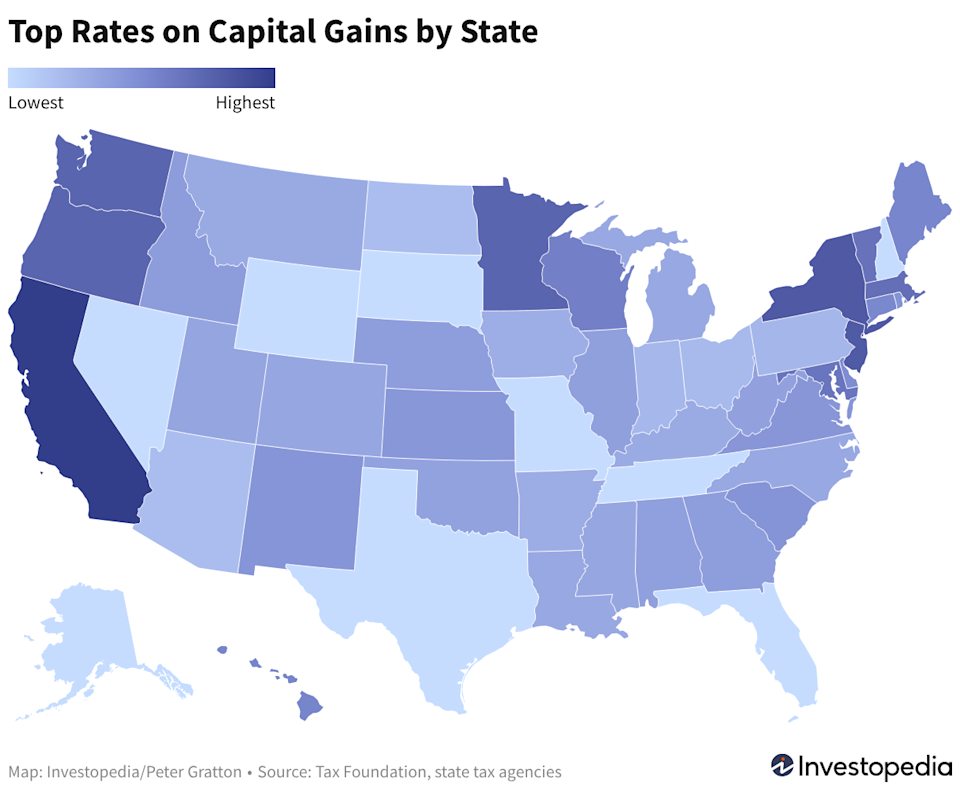
Nine states, including Texas, Florida and Missouri, don't tax capital gains.

Missouri became the first income-taxing state to fully exempt capital gains starting in 2025.

Maryland and Washington increased capital gains taxes in 2025, with Washington’s top rate reaching 9.9%.

Sell $500,000 in appreciated stock in California, and you’ll owe the state up to $66,500 if you make over $1 million. Make the same sale in Texas, and you’ll owe nothing since the state charges zero state tax on capital gains, dividends and investment income.

Neither do eight other states. Missouri joined the list in 2025, while Maryland and Washington have raised their taxes on capital gains in recent years.

In most states, capital gains, dividends and investment income are taxed the same way. The 41 states that tax income treat all three as ordinary income, using the same brackets at the same rates. Hawaii, North Dakota and New Mexico offer partial deductions on capital gains that don't apply to other investment income.

Eight states don’t tax personal income, including capital gains. Alaska, Florida, Nevada, South Dakota, Tennessee, Texas and Wyoming have never imposed them. New Hampshire joined the group in 2025 when its tax on interest and dividends expired.

Missouri is the outlier. It taxes wages, salaries, interest, and dividends at rates up to 4.7%. But a 2025 law allows individuals to deduct 100% of capital gains reported for federal purposes when calculating their state taxable income.

Not every state is lowering taxes on investments. Washington, which doesn't tax wages, imposed a 7% capital gains tax in 2022 on long-term gains above a threshold of about $250,000. The state recently added a 2.9% surcharge on gains above $1 million, pushing the top rate to 9.9%. Washington is among the highest-tax states for capital gains, alongside California (13.3%) and New York (10.9%). But it doesn't tax wages, dividends or interest at all.

Maryland, facing a $3.3 billion budget shortfall, enacted even broader changes. A 2025 law added a permanent 2% surtax on net capital gains for individuals with federal adjusted gross income above $350,000, in addition to a new top state income tax rate of 6.5%.

A 0% state capital gains rate doesn’t mean no tax bill. Federal long-term capital gains rates of 0%, 15% or 20% still apply based on your taxable income:

High earners may also owe the 3.8% Net Investment Income Tax once modified adjusted gross income exceeds $200,000 (single) or $250,000 (married filing jointly). Short-term gains (for assets held one year or less) are taxed at ordinary income rates, which run as high as 37%.

States with low or no taxes tend to make up revenue elsewhere. Texas and Florida lean on property and sales taxes. Alaska distributes oil royalties but has some of the highest costs of living in the country. Tennessee’s combined state and local sales tax rate is among the nation’s steepest.

Missouri’s approach highlights the trade-off in miniature: you save on capital gains, but dividends and interest are fully taxable. If your portfolio throws off more income than it does realized gains, Missouri’s exemption may be less valuable than it looks.

Read the original article on Investopedia