yahoo Press
This One ETF Gives Retirees Quiet Exposure to AI Infrastructure REITs
Images

1 / 5

2 / 5

3 / 5

4 / 5
5 / 5
Pacer Data & Infrastructure Real Estate ETF (SRVR) yields roughly 2% from REIT dividends, not options or bonds.

Top three holdings—Equinix, Digital Realty Trust, and American Tower—drive nearly 45% of SRVR’s income and dividend trajectory.

Distributions fluctuate quarterly based on underlying REIT payouts, making predictable income unlikely for traditional income investors.

If you're focused on picking the right stocks and ETFs you may be missing the bigger picture: retirement income. That is exactly what The Definitive Guide to Retirement Income was created to solve, and it's free today. Read more here

Income investors hunting for AI infrastructure exposure often land on Pacer Data & Infrastructure Real Estate ETF (NYSEARCA:SRVR). The fund packages data centers, cell towers, and related digital infrastructure REITs into a single, low-cost wrapper. The dividend safety question is more nuanced than the appeal.

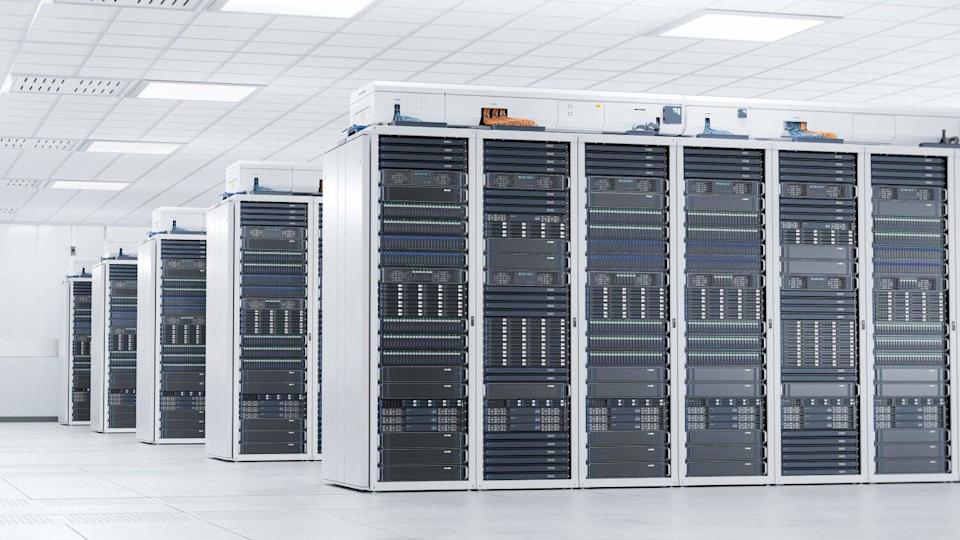
A modern data center features multiple rows of server racks filled with IT infrastructure, representing critical digital backbone.

If you're focused on picking the right stocks and ETFs you may be missing the bigger picture: retirement income. That is exactly what The Definitive Guide to Retirement Income was created to solve, and it's free today. Read more here

SRVR's yield comes entirely from dividends paid by the REITs and infrastructure companies it holds, not from options premiums or bond coupons. REITs must distribute at least 90% of taxable income to shareholders, which is why data center and tower REITs carry meaningful yields even at elevated share prices.

The fund tracks the Solactive GPR Data & Infrastructure Real Estate Index, charges 0.49% in annual expenses, and yields roughly 2%. That is modest by income standards. SRVR is a growth-plus-income play on digital infrastructure, and the dividend is best understood as a byproduct of the underlying REIT structure rather than the primary thesis.

Concentration defines SRVR's dividend profile. The top three holdings, Equinix (NASDAQ:EQIX) at 16.6%, Digital Realty Trust (NYSE:DLR) at 15.3%, and American Tower (NYSE:AMT) at 14%, represent roughly 45% of the portfolio. What happens to those three names largely determines what happens to the ETF's income stream.


Equinix (NASDAQ:EQIX), the world's largest carrier-neutral data center operator, raised its quarterly dividend to $5.16 per share alongside Q4 2025 results, marking 11 consecutive years of dividend growth. Management guided 2026 revenues of $10.1 to $10.2 billion, representing 10% to 11% growth. Full-year 2025 capital expenditures of $4.3 billion exceeded operating cash flow of $3.9 billion, producing negative GAAP free cash flow, but AFFO guidance of 2026 AFFO per share of $41.93 to $42.74 sits well above the annualized dividend. Demand is accelerating: roughly 60% of the largest Q4 deals were tied to AI workloads.

Digital Realty Trust (NYSE:DLR) has held a $1.22 quarterly dividend for over 16 consecutive quarters since mid-2022. The dividend has not grown in that period, but it has not been cut either. The stable payout reflects management's choice to preserve financial flexibility during heavy development spending rather than chase dividend growth at the expense of the balance sheet.

American Tower (NYSE:AMT) is the fund's most reliable income compounder, raising its quarterly dividend from $0.21 in 2012 to $1.79 declared for April 2026 over an unbroken streak spanning more than a decade. Full-year 2025 free cash flow reached $3.7 billion, providing substantial coverage. The company guided 2026 AFFO per share of $10.78 to $10.95, with the Q4 2025 dividend representing 4.9% year-over-year growth. Tower leases are long-term and non-cancellable, making its cash flows among the most predictable in the REIT universe.

Crown Castle (NASDAQ:CCI), at 3.96% of the fund, cut its quarterly dividend from $1.565 to $1.0625 starting in Q2 2025, a reduction of roughly 32%, after a strategic pivot away from its fiber business strained the balance sheet. It has since stabilized at $1.0625 per quarter through its most recent March 2026 distribution. The episode illustrates that even established infrastructure REITs can restructure dividends when business models shift.

The 10-year Treasury yield sits near 4.31%, up from a 12-month low of 3.97% in late February. The Fed Funds rate stands at 3.75%, cut from a peak of 4.5%. The direction is favorable for REITs, but the pace has slowed. Equinix's total debt principal grew to $21.4 billion in 2025, up from $17.6 billion the prior year, and refinancing costs above the low-rate era of 2020 to 2022 are a real drag even where AFFO coverage holds.

SRVR holds Cellnex Telecom at 4.7%, Europe's largest independent tower operator, plus Australian operator NEXTDC and Chinese data center company GDS Holdings. International positions add growth exposure but introduce currency risk. Equinix flagged foreign currency headwinds repeatedly in 2025, noting constant-currency growth exceeded as-reported growth by roughly two percentage points.

SRVR has gained 12.4% year-to-date and 10.6% over the past year, but the five-year picture is essentially flat, down about 1.6%, reflecting the damage the 2022 to 2023 rate-hiking cycle inflicted on leveraged real estate assets.

The distributions are variable. SRVR's payouts fluctuate based on what underlying REITs distribute each period, which is why the Q4 2025 payment of $0.43 dwarfed the Q1 2025 payment of $0.08. Investors expecting a predictable quarterly check will be disappointed.

Most investors spend years learning how to pick good stocks and funds. Far fewer have a clear plan for turning those investments into a reliable retirement paycheck. The truth is, the transition from “building wealth” to “living on wealth” is one of the most overlooked risks facing successful investors in their 50s, 60s and 70s.

That is exactly what The Definitive Guide to Retirement Income was created to solve. It’s a free guide that outlines the straightforward math and strategies you need to convert your investments to income. Learn more here.