Press
Annual UK borrowing falls by £20bn but Iran war clouds outlook
Images
1 / 9

2 / 9
3 / 9
4 / 9

5 / 9

6 / 9

7 / 9

8 / 9

9 / 9
UK government borrowing fell last year, but analysts say the improvement is not expected to last because of the impact of the Iran war.

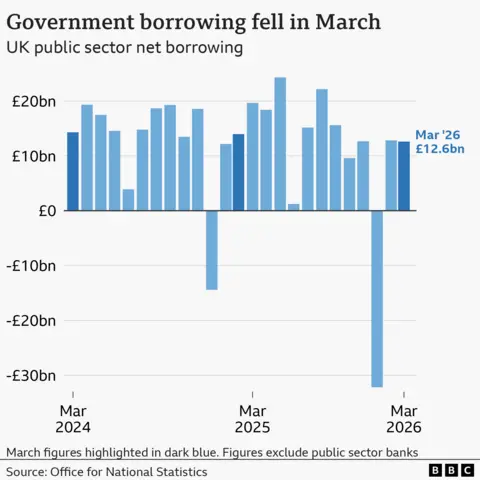
Borrowing, the difference between spending and income from taxes, fell £19.8bn to  £132bn in the year to March, the Office for National Statistics (ONS) said.

The total was slightly below the £132.7bn that had been predicted by the government's independent forecaster, the Office for Budget Responsibility.

However, analysts say government finances are likely to worsen this year if inflation picks up and if some households are offered support to cope with higher energy bills.

Ruth Gregory, deputy chief UK economist at Capital Economics, said the full impact from the energy price shock caused by the conflict "is still to come".

"We continue to think that the combination of some targeted energy price support, totalling about £20bn, high interest rates and the weakening economy will mean borrowing rises from £132bn in 2025/26 to about £145bn this year."

Elliott Jordan-Doak, senior UK economist at Pantheon Economics, said the chancellor was facing "a more daunting 2026/27 ahead".

He estimated that government is facing an increase of about £12bn in interest payments this year, and "any further fiscal support for households or businesses will require additional borrowing".

Last week, the International Monetary Fund (IMF) predicted the energy shock from the Iran war would hit the UK the hardest of the world's advanced economies.

The ONS said borrowing in the month of March was £12.6bn, which was higher than analysts had been expecting. However, the figure was £1.4bn less than a year earlier, and the lowest March borrowing since 2022.

For the year to March, the ONS said borrowing as a proportion of GDP was 4.3% - the lowest since 2019-20, just before the Covid pandemic.

"Although spending has risen this financial year, this was more than offset by increased receipts," said ONS senior statistician Tom Davis.

Chief Secretary to the Treasury, James Murray, said: "Our deficit is down £19.8bn because of our plan to cut borrowing. In a volatile world the decisions we are taking are the right ones to keep costs down, take back our energy security and cut borrowing and debt."

Shadow chancellor Mel Stride said the annual deficit was "70% higher than was forecast when they [Labour] came to office".

"Labour have left Britain dangerously exposed to economic shocks," he added.

The drop has been largely driven by a rise in the number of people not actively seeking work.

A key survey indicates growing doubt among shoppers over prospects for the UK economy in the next year.

Houmous and motorhomes are also added to the basket of goods and services used to chart the rising cost of living.

Suffolk sees a 251% increase in the number of ketamine users since 2022.

Analysts had been expecting 0.2% growth for the UK economy at the beginning of the year.