Press
‘Pure survival': How pop group XG endured a brutal six-year training to break through
Images

1 / 14

2 / 14

3 / 14

4 / 14

5 / 14
6 / 14

7 / 14

8 / 14

9 / 14
10 / 14

11 / 14

12 / 14

13 / 14

14 / 14
Every night, before they take the stage, the seven members of pop group XG form a circle and join hands. Band leader Jurin shouts "Hesono",  and the other members reply with a loud shout of "Oh", flinging their arms towards the sky.

They're not the only band to have pre-show ritual – but there's a special message behind XG's chant.

Hesono-o (or, more accurately へその緒) is the Japanese word for umbilical cord. It can symbolise someone's fate or destiny from birth. For XG, the phrase represents the intensity of their bond.

"We're so strongly connected, we're always thinking the same things," says Chisa, the group's oldest member.

"In our early days, I actually had a dream we were connected by an umbilical cord, like a mother and child.

"So I threw that out as an idea for our identity. People said, 'That's so new and interesting', and that's how the concept of Hesono-o was born."

XG talk to the BBC the morning after a triumphant (if rain-soaked) debut at Capital's Summertime Ball in Wembley Stadium.

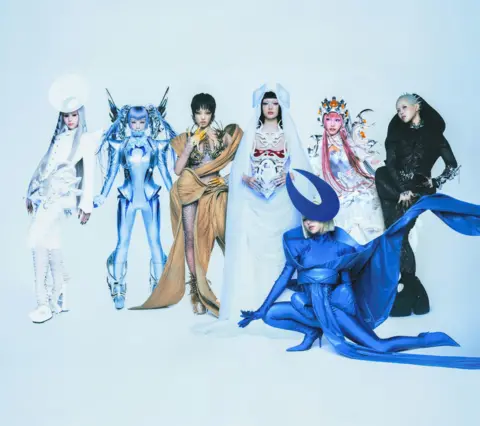
All seven members - Maya, Juria, Hinata, Harvey, Cocona, Chisa and Jurin - are dressed in vibrant neon outfits that erupt with tufts of faux fur and intricate belt buckles.

Cocona sports a necklace that reads "rock star". Harvey has so many bangles that she rattles as she walks.

Everyone has their own individual spin, but they move as one - and their camaraderie is conspicuous. Answering questions, they confer in a huddle before appointing a spokesperson.

It's a connection forged more than 10 years ago, when some of the band were only 11 or 12 years old.

XG's members were scouted from thousands of hopefuls across Japan in 2016. Twenty-one qualified for training, living together in dormitories while taking dawn to dusk lessons in singing, dancing and speaking in multiple languages.

The regime could be harsh. In a documentary capturing the band's early days, the trainees were berated for posting photos from their dorms on social media.

"You're never going to earn respect for doing that sort of thing," a tutor scolded the teens.

Another scene showed them performing squats until they fell sick, or burst into tears.

"It was the toughest and most difficult experience I've ever had," says Maya of the experience. "A battle against myself physically and mentally."

Looking back now, Chisa calls training an act of "pure survival". It was only when the candidates were split into teams that a sisterhood began to emerge.

"In a good way, we pushed each other to improve, so each team became really united," she says.

"From the middle to the later part of our trainee period, we started hanging out more – going out together, travelling, holding little sports days and things like that.

"We really loved watching movies together," adds Hinata. "Especially scary movies, because we would all huddle up together under a blanket, being scared together.

"It was like we were real-life siblings, you know? That feeling is something I really love."

After six years of effort, the band went public in 2022 with their debut single, Tippy Toes.

Set to a minimalist hip-hop beat, it showcased their ability to transition seamlessly from a rap flow to melodic vocal riffs. Lyrically, it set out their global ambitions.

"Understand that we didn't come to play," sang Hinata. "Here to dominate."

They made good on that promise with 2022's Galz Xypher, where the band's rap line (Jurin, Maya, Harvey, and Cocona) traded trilingual bars over a patchwork of samples including Aretha Franklin's One Step Ahead and Rosalía's Saoko.

A viral hit, it spawned thousands of reaction videos on TikTok, and racked up 49 million plays on YouTube.

Over subsequent releases – the exuberant Shooting Star, or the braggadocious Woke Up – they crystallised a musical vision that fused sci-fi aesthetics to the elastic grooves of 90s R&B.

By 2025, they were booked to play Coachella, where they were the only Japanese act on the line-up.

"I still get chills when I watch it back," says Maya. "I'm like, 'Oh my God, I'm gonna work hard until I can get back on that stage'."

As XG's career exploded, however, their youngest member, Cocona, was undergoing a more personal transformation.

Last December, on their 20th birthday, they came out as transmasculine and non-binary in a heartfelt Instagram post.

"I want to share something that's been in my heart for a long time," they wrote.

"I was born and perceived as female, but that label never represented who I truly am... The hardest thing I've ever faced was accepting and embracing myself."

Transmasculine refers to people who are born female but identify as more masculine, whether partially or fully. Non-binary is an umbrella term for gender identities that do not fit within "male" or "female" categories.

Cocona's statement was almost unprecedented in the tightly-controlled world of J-pop and idol music - but it came with their bandmates' full support.

Jurin took the artistically composed photos that accompanied the announcement, which showed Cocona's scars from top surgery, while Chisa did their makeup.

XG fans responded with a similar outpouring of love and acceptance.

"I was really, really grateful for that," Cocona says. "I hope through me saying what I did, that other people will feel a sense of hope or light or love.

"Thinking that way makes me feel like I can keep going and work even harder, so I feel very blessed."

After Cocona's announcement, XG's identity also changed. The band's initials, which originally stood for Xtraordinary Girls, now represent "Xtraordinary Genes," reflecting a message, that "it's okay to be yourself as you are", says Chisa.

"Breaking fixed ideas and preconceptions is a big part of our concept," agrees Jurin.

That's also the theme of their new album, The Core, where the band ditch the throwback R&B of their first EPs for a more expansive sound.

Lead single Gala has a Vogue-inspired ballroom beat; while Hypnotise takes inspiration from the chunky house piano of CeCe Peniston's Finally.

"When we first heard that iconic piano sound, we instantly thought, 'This has to be our title track'," says Maya. "It's not just danceable, it has a kind of dark, mysterious feel, and it makes you picture the city at night."

Another standout is O.R.B, which pairs squealing guitars with a message of "bro solidarity". (Unsurprisingly, it's been interpreted as a declaration of support for Cocona.)

"We told our producer we wanted a band-style rock song," recalls Chisa.

"We never imagined the demo would make it onto the album, but when we listened to it together, it really reminded us of Avril Lavigne and we all felt, 'This is exactly what we want to do'.

"It's a track that expands our musical gravity, our musical universe."

British fans can explore that universe when XG play their first UK show at Wembley Arena this September.

Part of a year-long world tour, Juria says the concerts "will truly embody the album's title. Our core will be right there on stage".

The tour means demands on their time are escalating, but XG will ensure their umbilical cord is never cut.

"Having a clear on/off switch is really important," says Hinata. "For me, spending downtime with the members really helps me stay balanced."

To relax, she watches anime. Jurin, formerly a professional snowboarder, gets back on the slopes when she can. And Harvey has a secret talent for playing trombone.

"How did you know about that?!" she laughs.

"I haven't played properly since I was in third grade of junior high, but I do carry around the mouthpiece with me... So I'd love to play trombone with the band one day, just to see if I can still do it."

The campaign to make it happen starts here.

Some see a double standard: Japanese men who clean in public while their wives do all the housework.

Former Tottenham midfielder Rafael van der Vaart apologises after saying that Japan players "all look alike" during their 2-2 draw with the Netherlands.

Mike Shinoda from the band says he spotted Megan Da Savage's rap on an independent music platform.

Japan needs to revisit the pacifist posture that has defined it since World War Two, Shinjiro Koizumi says.

Bear attacks are at a record high in Japan, so officials in Tochigi held drills on how to respond to them.